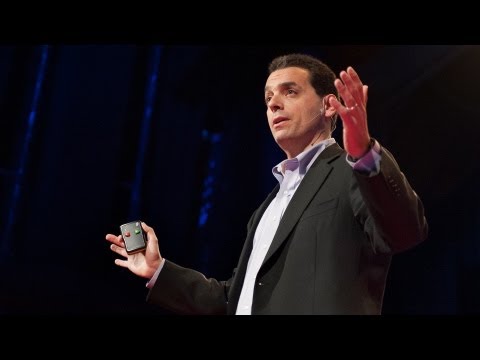
The puzzle of motivation | Dan Pink | TED
- By
- TED
- Length
- 19 min
- Language
- English
- Text from
- the video's captions
- Transcribed
- 27 September 2026
Summary
Dan Pink argues that traditional carrot-and-stick incentives fail for creative, conceptual work and often make performance worse. Drawing on the candle problem, studies by Sam Glucksberg, Dan Ariely and the Federal Reserve, he shows that contingent rewards narrow focus and block creativity. He proposes a new business operating system built on intrinsic motivation: autonomy, mastery and purpose, illustrated by Atlassian, Google's 20% time, ROWE and Wikipedia's triumph over Encarta.
Key points
- In Sam Glucksberg's candle problem experiment, the group offered cash rewards took on average 3.5 minutes longer to solve the problem than the unpaid group.
- Contingent if-then rewards work well only for tasks with simple rules and a clear destination, but they dull thinking and block creativity on open-ended problems.
- A study of MIT students by Dan Ariely and colleagues found that once a task required even rudimentary cognitive skill, larger rewards led to poorer performance, a result replicated in Madurai, India.
- The research showing financial incentives can negatively impact performance was sponsored by the Federal Reserve Bank of the United States, not a left-wing think tank.
- Economists at the London School of Economics reviewed 51 studies of pay-for-performance plans and found financial incentives can have a negative impact on overall performance.
- Pink proposes a new operating system for business built on three elements of intrinsic motivation: autonomy, mastery and purpose.
- Examples of autonomy in practice include Atlassian's FedEx Days, Google's 20% time, and Results Only Work Environments (ROWE), all of which improved productivity, engagement and satisfaction.
- Wikipedia, built by unpaid volunteers motivated intrinsically, defeated Microsoft's incentive-driven Encarta encyclopedia, which Pink calls a knockout for intrinsic motivation.
- Pink argues management is a human invention, not natural law, and that traditional management is great for compliance while self-direction works better for engagement.
Questions it answers
00:00Opening the case
Why is Dan Pink making a case rather than telling a story?
Pink, a former law student, says he wants to make a hard-headed, evidence-based, lawyerly case for rethinking how we run our businesses. He frames the audience as the jury.
- Pink attended law school in the late 1980s but never practiced law.
- He intends to present evidence, not anecdotes or feelings.
01:47The candle problem
What is the candle problem and why does it matter?
Created by Karl Duncker in 1945, it asks participants to attach a candle to a wall using thumbtacks and matches so wax doesn't drip on the table. Solving it requires overcoming functional fixedness by seeing the tack box as a platform.
- The box holding the tacks is the key to the solution.
- The task is a stand-in for creative, non-obvious problems.
03:18Incentives backfire
What happened when Sam Glucksberg offered money for solving the candle problem faster?
The incentivized group took on average 3.5 minutes longer than the group being timed for norms. Pink notes this finding has been replicated for nearly 40 years and is one of the most robust, yet most ignored, findings in social science.
- If-then rewards dulled thinking and blocked creativity.
- When the tacks were presented out of the box, the incentivized group won, showing rewards work for simple, clear tasks.
07:33Why this matters now
Why do contingent rewards fail for modern work?
Rewards narrow focus, which helps with rule-based tasks but hurts when the solution is on the periphery. Routine left-brain work like some accounting, financial analysis and programming is easy to outsource or automate, so creative, conceptual abilities matter more.
- Everyone is dealing with their own version of the candle problem.
- Rules are mystifying and solutions are surprising and not obvious in real work.
08:32The scientific evidence
What does the research show about pay-for-performance?
Dan Ariely's MIT study found higher rewards improved mechanical skill but worsened performance on tasks requiring even rudimentary cognitive skill, a result replicated in Madurai, India. The research was sponsored by the Federal Reserve, and LSE economists reviewing 51 studies found financial incentives can negatively impact overall performance.
- In eight of nine tasks across three experiments, higher incentives led to worse performance.
- The findings come from economists at MIT, Carnegie Mellon, the University of Chicago and LSE.
12:01A new operating system
What should replace carrots and sticks?
Pink proposes intrinsic motivation built on autonomy, mastery and purpose. Management is a human invention suited for compliance, while self-direction works better for engagement.
- Autonomy is the urge to direct our own lives.
- Mastery is the desire to get better at something that matters.
- Purpose is the yearning to serve something larger than ourselves.
13:35Autonomy in practice
What do real examples of autonomy look like?
Atlassian's FedEx Days let engineers work on anything for 24 hours, Google's 20% time produced products like Gmail and Google News, and ROWE workplaces with no schedules see productivity, engagement and satisfaction rise while turnover falls.
- Pay people adequately and fairly first, then give lots of autonomy.
- About half of Google's new products in a typical year come from 20% time.
16:45Encarta vs. Wikipedia
What happened when paid and volunteer encyclopedias went head to head?
Microsoft's Encarta used paid professionals and managers, while Wikipedia used unpaid volunteers doing it for fun. Pink says no economist ten years ago would have predicted Wikipedia's model would win, but intrinsic motivation won in a knockout.
- Pink calls it the Ali-Frazier of motivation, the Thrilla in Manila.
- Intrinsic motivators beat extrinsic motivators decisively.
Notes
The Case Against Carrots and Sticks
Dan Pink frames his talk as a lawyerly case for rethinking how businesses motivate people. His central claim: there is a mismatch between what science knows and what business does.
The Candle Problem
- Created in 1945 by psychologist Karl Duncker.
- Participants get a candle, thumbtacks and matches and must attach the candle to the wall so wax doesn't drip on the table.
- The solution requires overcoming functional fixedness: seeing the tack box as a platform, not just a container.
Glucksberg's Experiment
- Sam Glucksberg, now at Princeton, timed two groups solving the candle problem.
- One group was timed for norms; the other was offered $5 for top 25% and $20 for the fastest time.
- The incentivized group took 3.5 minutes longer on average.
- When the tacks were presented out of the box, the incentivized group won, showing if-then rewards work for simple, rule-based tasks with a clear destination.
The Evidence
- Dan Ariely and colleagues tested MIT students with games involving creativity, motor skills and concentration at three reward levels. Mechanical skill improved with higher pay; even rudimentary cognitive skill led to worse performance with larger rewards.
- Replicated in Madurai, India: in eight of nine tasks across three experiments, higher incentives led to worse performance.
- The research was sponsored by the Federal Reserve Bank of the United States.
- Economists at the London School of Economics reviewed 51 pay-for-performance studies and found financial incentives can negatively impact overall performance.
The New Operating System
Pink proposes intrinsic motivation built on three elements:
- Autonomy: the urge to direct our own lives.
- Mastery: the desire to get better at something that matters.
- Purpose: the yearning to serve something larger than ourselves.
Autonomy in Practice
- Atlassian's FedEx Days: engineers work on anything for 24 hours, producing many software fixes.
- Google's 20% time: about half of new products in a typical year, including Gmail, Orkut and Google News.
- ROWE (Results Only Work Environment): no schedules, optional meetings, work done how/when/where employees choose; productivity, engagement and satisfaction rise, turnover falls.
Encarta vs. Wikipedia
Microsoft's paid, managed Encarta lost to Wikipedia's unpaid volunteer model, which Pink calls the Ali-Frazier of motivation, with intrinsic motivation winning in a knockout.
Text from the video's own captions. Summary and notes written by AI from the transcript, so check anything important against the recording.
More from TED
- Elon Musk: The future we're building -- and boring | TED
YouTube · 41 min
- The power of introverts | Susan Cain | TED
YouTube · 19 min
- How to Make Stress Your Friend | Kelly McGonigal | TED
YouTube · 14 min
- The next outbreak? We’re not ready | Bill Gates | TED
YouTube · 9 min
- The happy secret to better work | Shawn Achor
YouTube · 12 min