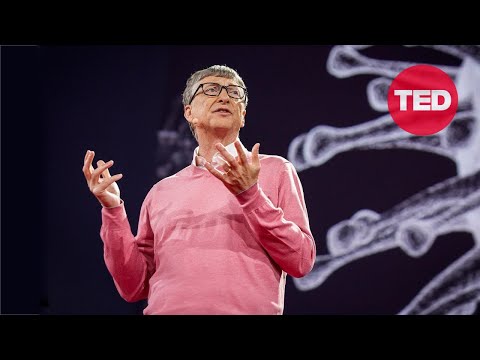
The next outbreak? We’re not ready | Bill Gates | TED
- By
- TED
- Length
- 9 min
- Language
- English
- Text from
- the video's captions
- Transcribed
- 27 September 2026
Summary
Bill Gates argues that the biggest global catastrophe risk in the coming decades is not nuclear war but a highly infectious virus. Using the Ebola outbreak as an example, he shows that the world had no real system to respond to epidemics. He outlines what a preparedness system would need, from strong health systems to medical reserves and R&D, and says the cost would be modest compared to the harm of a worldwide flu epidemic.
Key points
- Gates says a highly infectious virus is more likely than war to kill over 10 million people in the next few decades.
- The Ebola response failed because there was no system at all, not because a system worked poorly.
- Ebola didn't spread further due to heroic health workers, the virus's nature, and luck in avoiding urban areas.
- A virus like the 1918 Spanish Flu, spread through the air, killed over 30 million people.
- Preparedness should mirror military readiness: strong health systems, a medical reserve corps, military partnership, germ games, and R&D.
- The last germ game in the United States was in 2001, and it didn't go well.
- The World Bank estimates a worldwide flu epidemic would reduce global wealth by over three trillion dollars.
- Gates says there's no need to panic, but we need to get going because time is not on our side.
Questions it answers
00:17The real global risk
What is the greatest risk of global catastrophe today?
Gates says it is a highly infectious virus rather than a war — not missiles, but microbes. He contrasts this with the nuclear war fears of his childhood.
- A virus is more likely than war to kill over 10 million people in the next few decades.
- We have invested heavily in nuclear deterrents but very little in stopping epidemics.
01:20Ebola's lessons
What went wrong in the Ebola response?
The problem was not a system that failed but that there was no system at all. There were no ready epidemiologists, no medical teams, inaccurate paper-based case reports, and no one examining treatment approaches or diagnostics.
- There was no group of epidemiologists or medical team ready to deploy.
- Case reports came in on paper, delayed and extremely inaccurate.
- The WHO is funded to monitor epidemics, not to do these response tasks.
03:07Why Ebola wasn't worse
Why didn't Ebola spread further, and why might we not be so lucky next time?
Heroic health worker efforts, the nature of the virus, and the fact that it stayed out of urban areas limited the spread. A future virus could spread through the air or let infectious people feel well enough to travel, making it dramatically worse.
- Ebola does not spread through the air, and contagious people are mostly bedridden.
- It never got into many urban areas — that was just luck.
- A virus spread through the air, like the 1918 Spanish Flu, killed over 30 million people.
05:00Building a response system
How can we prepare for the next epidemic?
We can build a good response system using cell phones, satellite maps, and advances in biology. Gates says the best lessons come from how we prepare for war, with full-time forces, reserves, rapid mobile units, and exercises.
- Cell phones, satellite maps, and advances in biology can support a global health system.
- We need strong health systems in poor countries to spot outbreaks early.
- The last U.S. germ game was in 2001 — so far the score is germs: 1, people: 0.
06:37Key pieces and cost
What are the key pieces of preparedness and what would they cost?
Strong health systems in poor countries, a medical reserve corps, pairing medical people with the military, germ games, and advanced R&D in vaccines and diagnostics. Gates has no exact budget but says it is very modest compared to the potential harm.
- Pair medical people with the military for speed, logistics, and security.
- The World Bank estimates a worldwide flu epidemic would cut global wealth by over three trillion dollars.
- Ebola can serve as an early warning to get ready for the next epidemic.
Notes
The threat
- Gates recalls worrying about nuclear war as a kid, with a barrel of food and water in the basement.
- Today, if anything kills over 10 million people in the next few decades, it is most likely to be a highly infectious virus — not missiles, but microbes.
- We have invested hugely in nuclear deterrents but very little in a system to stop an epidemic.
What Ebola revealed
- Gates followed Ebola through the case analysis tools used to track polio eradication.
- The problem was not a system that didn't work well enough — there was no system at all.
- Missing pieces: no epidemiologists ready to go, no medical team, case reports on paper that were delayed and extremely inaccurate.
- Médecins Sans Frontières did a great job orchestrating volunteers, but a large epidemic would require hundreds of thousands of workers.
- No one looked at treatment approaches or diagnostics; using survivors' plasma was never tried.
- The WHO is funded to monitor epidemics, not to do these response tasks.
Why Ebola wasn't worse
- About 10,000 people died, nearly all in three West African countries.
- Three reasons it didn't spread more: heroic health workers, the virus doesn't spread through the air and contagious people are bedridden, and it didn't reach many urban areas — that was just luck.
- A future virus could let people feel well enough while infectious to get on a plane or go to a market.
- The source could be a natural epidemic or bioterrorism.
- A virus spread through the air, like the 1918 Spanish Flu, killed over 30 million people.
How to prepare
- We have the tools: cell phones for information, satellite maps to see movement, and advances in biology to speed up drugs and vaccines.
- Lessons from war preparation: full-time soldiers, reserves, NATO's rapid mobile unit, and war games to test readiness.
- Key pieces: strong health systems in poor countries, a medical reserve corps, pairing medical people with the military, germ games instead of war games, and advanced R&D in vaccines and diagnostics.
- The last U.S. germ game was in 2001 and didn't go well — the score is germs: 1, people: 0.
- The Adeno-associated virus is one breakthrough that could work very quickly.
Cost and stakes
- No exact budget, but the cost is very modest compared to the potential harm.
- The World Bank estimates a worldwide flu epidemic would cut global wealth by over three trillion dollars with millions of deaths.
- These investments also reduce global health equity gaps and make the world more just and more safe.
- No need to panic, but we need to get going — Ebola can serve as an early warning, a wake-up call.
Text from the video's own captions. Summary and notes written by AI from the transcript, so check anything important against the recording.
More from TED
- Elon Musk: The future we're building -- and boring | TED
YouTube · 41 min
- The power of introverts | Susan Cain | TED
YouTube · 19 min
- How to Make Stress Your Friend | Kelly McGonigal | TED
YouTube · 14 min
- The happy secret to better work | Shawn Achor
YouTube · 12 min
- The puzzle of motivation | Dan Pink | TED
YouTube · 19 min