How Great Leaders Inspire Action | Simon Sinek | TED
- By
- TED
- Length
- 18 min
- Language
- English
- Text from
- the video's captions
- Transcribed
- 27 September 2026
Summary
Simon Sinek explains why some leaders and organizations inspire while others don't, arguing that inspiring leaders like Apple, Martin Luther King, and the Wright brothers all think, act, and communicate the same way — starting with
Key points
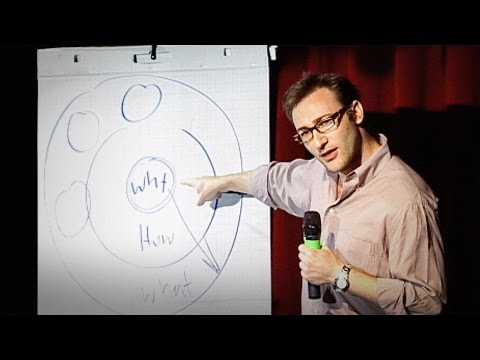
- Sinek codified a pattern called the golden circle: Why, How, What.
- Inspired leaders and organizations communicate from the inside out, starting with why.
- People don't buy what you do; they buy why you do it.
- The golden circle correlates with the human brain: the neocortex handles rational thought, while the limbic brain controls feelings, decision-making, and behavior but has no capacity for language.
- The Wright brothers succeeded because they were driven by a cause and belief, while the better-funded Samuel Pierpont Langley was motivated by riches and fame and quit after they beat him.
- The law of diffusion of innovation says mass-market success requires crossing a tipping point of 15 to 18 percent market penetration.
- TiVo failed commercially because it communicated what its product did rather than what it believed.
- Martin Luther King drew 250,000 people to Washington because he told people what he believed, and people showed up for themselves, not for him.
Questions it answers
00:16The opening puzzle
Why do some leaders and organizations achieve things that defy all assumptions?
Sinek asks why Apple is so innovative, why Martin Luther King led the Civil Rights Movement, and why the Wright brothers beat better-funded teams. He concludes there's a pattern: all great inspiring leaders think, act, and communicate the exact same way — the complete opposite of everyone else.
- Apple has the same access to talent and agencies as its competitors, yet outperforms them.
- Sinek codified this pattern as the golden circle.
02:11The golden circle
What is the golden circle and why does it matter?
It consists of Why, How, What. Everyone knows what they do, some know how, but very few know why — their purpose, cause, or belief, not profit. Inspired leaders think, act, and communicate from the inside out, while everyone else goes from the outside in.
- "Why" means purpose, cause, or belief — profit is just a result.
- Most communication starts with the clearest thing (what) and ends with the fuzziest (why).
02:58Apple example
How does inside-out communication change how people respond?
Sinek contrasts a typical "we make great computers" pitch with Apple's "we believe in challenging the status quo" message. Reversing the order of the information proves people don't buy what you do; they buy why you do it.
- Customers comfortably buy phones, MP3 players, and DVRs from Apple, a computer company.
- Gateway's flat-screen TVs and Dell's MP3 players failed despite equal qualifications.
06:05The biology of gut decisions
Why do gut decisions happen, and why does starting with why work?
The brain's three components correlate with the golden circle: the neocortex handles rational thought and language, while the limbic brain controls feelings, decision-making, and behavior but has no capacity for language. Communicating from the inside out talks directly to the part of the brain that controls behavior.
- Facts and figures can be understood but don't drive behavior.
- "It doesn't feel right" reflects the limbic brain's lack of language.
08:10Wright brothers vs. Langley
Why did the underfunded Wright brothers beat Samuel Pierpont Langley?
Langley had $50,000 from the War Department, the best minds, and great market conditions, but was motivated by riches and fame. The Wright brothers, funded by their bicycle shop with no college-educated team, were driven by a belief that flight would change the world — and their team worked with blood, sweat, and tears.
- The Wright brothers flew on December 17th, 1903.
- Langley quit the day they succeeded, proving he was motivated by the wrong thing.
- Hire people who believe what you believe, and they'll work with blood, sweat, and tears.
11:02Law of diffusion of innovation
How do you achieve mass-market acceptance of an idea?
The population breaks into innovators (2.5%), early adopters (13.5%), early majority, late majority, and laggards. Mass-market success requires crossing a tipping point of 15 to 18 percent market penetration, because the early majority won't try something until someone else has first.
- The gap between early adopters and early majority is "crossing the chasm," per Jeffrey Moore.
- Early adopters make gut decisions driven by what they believe, like standing in line six hours for an iPhone.
13:12TiVo's failure
Why did TiVo fail commercially despite being the highest-quality product?
TiVo told people what it had — a product that pauses live TV, skips commercials, and memorizes viewing habits — and the cynical majority rejected it. If it had started with what it believed ("if you're the kind of person who likes to have total control over every aspect of your life"), it would have communicated to the part of the brain that drives behavior.
- TiVo was well-funded with fantastic market conditions but never made money.
- Its stock went from about 30 or 40 dollars at IPO to never trading above 10.
15:17Martin Luther King's success
How did Dr. King draw 250,000 people to Washington without invitations or a website?
He told people what he believed — "I believe, I believe, I believe" — and people who believed the same made his cause their own and spread it. People showed up for themselves, not for him; 25% of the audience was white. He gave the "I have a dream" speech, not the "I have a plan" speech.
- We follow those who lead not because we have to, but because we want to.
- Those who start with "why" have the ability to inspire those around them.
Notes
The Golden Circle
- Sinek's discovery: all great inspiring leaders and organizations think, act, and communicate the exact same way — the opposite of everyone else.
- The golden circle has three levels: Why, How, What.
- Every organization knows what they do; some know how; very few know why — meaning purpose, cause, or belief, not profit.
People Buy Why You Do It
- Most communication goes from the outside in: what, how, and then an expected behavior. It's uninspiring.
- Apple reverses the order: "Everything we do, we believe in challenging the status quo... We just happen to make great computers."
- People don't buy what you do; they buy why you do it. That's why customers buy MP3 players and phones from Apple but not from Dell or Gateway.
The Biology
- The golden circle correlates with the brain's structure: the neocortex handles rational, analytical thought and language (the "what").
- The limbic brain controls feelings like trust and loyalty, all decision-making and behavior — but has no capacity for language.
- Gut decisions ("it just doesn't feel right") come from the limbic brain, which is why communicating from the inside out drives behavior.
The Wright Brothers vs. Langley
- Samuel Pierpont Langley had $50,000 from the War Department, the best minds, and great market conditions — but he wanted riches and fame.
- The Wright brothers had no money and no college-educated team, but were driven by a belief that flight would change the world.
- On December 17th, 1903, the Wright brothers took flight; Langley quit the same day.
- If you hire people who believe what you believe, they'll work with blood and sweat and tears; if you hire them just for a job, they'll work for your money.
The Law of Diffusion of Innovation
- Categories: innovators (2.5%), early adopters (13.5%), early majority, late majority, laggards.
- Mass-market success requires a tipping point between 15 and 18 percent market penetration — "crossing the chasm," as Jeffrey Moore calls it.
- TiVo failed commercially because it communicated features ("pauses live TV, skips commercials") instead of belief.
- Dr. King gave the "I have a dream" speech, not the "I have a plan" speech — 250,000 people showed up for themselves, not for him.
Text from the video's own captions. Summary and notes written by AI from the transcript, so check anything important against the recording.
More from TED
- Elon Musk: The future we're building -- and boring | TED
YouTube · 41 min
- The power of introverts | Susan Cain | TED
YouTube · 19 min
- How to Make Stress Your Friend | Kelly McGonigal | TED
YouTube · 14 min
- The next outbreak? We’re not ready | Bill Gates | TED
YouTube · 9 min
- The happy secret to better work | Shawn Achor
YouTube · 12 min