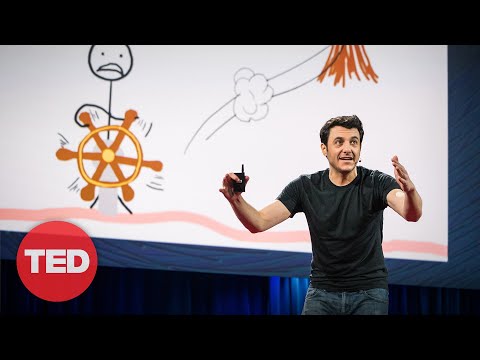
Inside the Mind of a Master Procrastinator | Tim Urban | TED
- By
- TED
- Length
- 14 min
- Language
- English
- Text from
- the video's captions
- Transcribed
- 27 September 2026
Summary
Tim Urban, writer of the blog Wait But Why, humorously explains procrastination through his own college thesis disaster and a mental model of three characters: the Rational Decision-Maker, the Instant Gratification Monkey, and the Panic Monster. He argues that deadline-driven procrastination is contained by panic, but a second, quieter kind of procrastination happens where there are no deadlines, causing long-term unhappiness. He concludes that everyone procrastinates on something and urges the audience to confront their own 'Life Calendar' before the boxes run out.
Key points
- Tim Urban wrote his entire 90-page senior thesis in 72 hours, pulling two all-nighters, and it was very, very bad.
- The procrastinator's brain contains both a Rational Decision-Maker and an Instant Gratification Monkey.
- The Monkey lives entirely in the present and only cares about easy and fun.
- The Dark Playground is where unearned leisure happens at the wrong time, filled with guilt, dread, anxiety and self-hatred.
- The Panic Monster wakes up when deadlines get close or public embarrassment looms, and is the only thing the Monkey fears.
- There are two kinds of procrastination: deadline-based, contained by the Panic Monster, and long-term non-deadline procrastination, whose effects extend outward forever.
- Long-term procrastination makes people feel like spectators in their own lives, unable even to start chasing their dreams.
- Urban believes non-procrastinators don't exist, and shows a Life Calendar with one box for every week of a 90-year life.
Questions it answers
00:12The thesis story
How did Tim Urban's procrastination show up in college?
He delayed every paper, and for his 90-page senior thesis he wrote nothing until three days before the deadline, then wrote all 90 pages over 72 hours, pulling two all-nighters. The thesis turned out to be very, very bad.
- Urban wrote 90 pages in 72 hours with two all-nighters.
- The thesis turned out very, very bad.
03:12Two brains compared
What did Urban's MRI comparison of procrastinator and non-procrastinator brains reveal?
Both brains have a Rational Decision-Maker, but the procrastinator's brain also contains an Instant Gratification Monkey, who seizes control and chooses easy and fun activities over productive work.
- Both brains have a Rational Decision-Maker.
- The procrastinator's brain also has an Instant Gratification Monkey.
04:44The Monkey and the Dark Playground
Why does the Instant Gratification Monkey take over, and what is the Dark Playground?
The Monkey lives entirely in the present and only cares about easy and fun, which conflicts with the Rational Decision-Maker's long-term plans. The Dark Playground is where leisure happens when it shouldn't, and its fun is unearned and filled with guilt, dread, anxiety and self-hatred.
- The Monkey only cares about easy and fun.
- The Dark Playground is filled with guilt, dread, anxiety and self-hatred.
06:50The Panic Monster
How does a procrastinator ever get to work?
The Panic Monster wakes up when a deadline gets too close or there's danger of public embarrassment or career disaster, and he's the only thing the Monkey is terrified of. When he wakes, the Monkey flees and the Rational Decision-Maker can take the wheel.
- The Panic Monster wakes up when deadlines get close or public embarrassment looms.
- He is the only thing the Monkey fears.
07:34TED Talk example
How did the Panic Monster play out with this very TED Talk?
Urban accepted the invitation but spent months doing things like scrolling Google Earth over India instead of working. When TED published the speaker list and he saw his own face, the Panic Monster woke up, the Monkey fled up the tree, and he finally started working on the talk.
- Urban procrastinated on his TED Talk for months.
- Seeing his face on the TED website woke the Panic Monster.
09:59The second kind of procrastination
Why did readers' emails reveal a darker problem than deadline procrastination?
Urban realized there are two kinds of procrastination: the deadline-based kind, where the Panic Monster contains the damage, and long-term procrastination where there are no deadlines, such as entrepreneurial or artistic pursuits, family, health and relationships. Without deadlines the Panic Monster never shows up, so the effects extend outward forever and cause long-term unhappiness and regret.
- Non-deadline procrastination is invisible and suffered privately.
- It makes people spectators in their own lives.
12:49The Life Calendar
What does Urban want everyone to take away at the end?
He believes non-procrastinators don't exist, since the Monkey's sneakiest trick works when deadlines aren't there. He shows a Life Calendar with one box per week of a 90-year life and urges everyone to look at it, figure out what they're procrastinating on, and stay aware of the Instant Gratification Monkey, starting today or sometime soon.
- Everyone is procrastinating on something.
- The job of watching the Monkey should start today, or sometime soon.
Notes
Tim Urban's procrastination story
- In college, Urban wrote every paper at the last minute; his 90-page senior thesis was written in 72 hours with two all-nighters.
- The thesis was "very, very bad" — he jokes that the school called to say it was the best ever, then admits that did not happen.
The brain model
- Both brains have a Rational Decision-Maker, but the procrastinator's brain also has an Instant Gratification Monkey.
- The Monkey lives entirely in the present, has no memory of the past or knowledge of the future, and only cares about easy and fun.
- The Rational Decision-Maker lets us visualize the future, see the big picture, and make long-term plans.
- Sometimes they agree (dinner, bed, well-earned leisure), but conflict arises when harder, less pleasant tasks make sense for the big picture.
The Dark Playground
- Where leisure happens when it shouldn't; the fun is unearned and filled with guilt, dread, anxiety, and self-hatred.
The Panic Monster
- Dormant most of the time, but wakes when a deadline gets too close or there's danger of public embarrassment or career disaster.
- He is the only thing the Monkey is terrified of; when he wakes, the Rational Decision-Maker takes the wheel.
- Example: Urban procrastinated on this very TED Talk for six months until TED released the speaker list and he saw his own face.
Two kinds of procrastination
- Deadline-based: effects are contained short-term because the Panic Monster intervenes.
- Long-term, non-deadline: careers as self-starters (arts, entrepreneurial), family, health, relationships — the Panic Monster never shows up, so effects extend outward forever.
- This kind is less visible, suffered quietly and privately, and causes long-term unhappiness and regret; people feel like spectators in their own lives, unable even to start chasing their dreams.
Conclusion
- Urban believes non-procrastinators don't exist; the Monkey's sneakiest trick is when deadlines aren't there.
- The Life Calendar: one box per week of a 90-year life — not that many boxes.
- Everyone is procrastinating on something; stay aware of the Monkey, and the job should probably start today — well, maybe not today, but sometime soon.
Text from the video's own captions. Summary and notes written by AI from the transcript, so check anything important against the recording.
More from TED
- Elon Musk: The future we're building -- and boring | TED
YouTube · 41 min
- The power of introverts | Susan Cain | TED
YouTube · 19 min
- How to Make Stress Your Friend | Kelly McGonigal | TED
YouTube · 14 min
- The next outbreak? We’re not ready | Bill Gates | TED
YouTube · 9 min
- The happy secret to better work | Shawn Achor
YouTube · 12 min