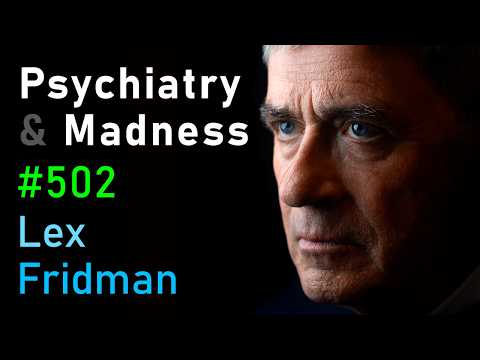
Psychiatry, Insane Asylums, Mental Illness, ECT, Lobotomies, Freud & Jung | Lex Fridman Podcast #502
- Length
- 3 h 37 min
- Language
- English
- Text from
- the video's captions
- Transcribed
- 27 September 2026
Summary
Historian Andrew Scull joins Lex Fridman for a sweeping conversation about the history of psychiatry, from the asylum era and eugenics to lobotomies, insulin coma therapy, ECT, psychoanalysis, and modern psychopharmacology. Scull argues that psychiatry remains in crisis: its diagnostic categories are faltering, its drugs offer only partial symptomatic relief with serious side effects, and public policy has abandoned the seriously mentally ill. Yet he insists on hope, noting real progress in some areas and the dedication of well-meaning clinicians.
Key points
- Scull argues psychiatry has made only limited progress and offers symptomatic treatments, not cures—there is no psychiatric penicillin.
- The DSM-III's 1980 symptom-based diagnostic system improved reliability but not validity, and genetics and neuroscience have failed to replace it despite over $20 billion in NIMH spending.
- Degeneration theory and eugenics led to over 60,000 sterilizations in the US and influenced Nazi programs that killed roughly a quarter million mentally ill people.
- Desperate remedies like Henry Cotton's surgical bacteriology, insulin coma therapy, Metrazol seizures, and lobotomy caused widespread harm before controlled trials and generational change discredited them.
- ECT has an abusive history as a tool of discipline but modern evidence suggests it can work for severe, treatment-resistant depression, though no one knows why.
- Psychoanalysis conquered American psychiatry mid-century but was displaced by clinical psychologists' shorter, testable therapies like CBT and by the drug revolution that began with chlorpromazine in the 1950s.
- Antipsychotics and antidepressants are only partially effective, psychiatrists cannot predict who will respond, and side effects like tardive dyskinesia and emotional numbing are serious.
- Scull calls for more humility, more research on psychosocial dimensions of mental illness, and warns against hype around ketamine and psychedelics.
Questions it answers
00:00Psychiatry's crisis today
Why does Andrew Scull say psychiatry is in crisis?
Psychiatry offers only symptomatic treatments, not cures, and its drugs and psychotherapies are at best partially effective. Diagnosis, drug treatments, and public policy for the seriously mentally ill are all faltering simultaneously.
- No psychiatric penicillin exists for any major mental illness.
- Treatments can create iatrogenic problems, and psychiatrists cannot predict who will respond well.
- People with serious mental illness die 15–25 years earlier than average.
05:35The DSM and diagnosis
How did the DSM's symptom-based system come about and why is it failing?
DSM-III in 1980 created a tick-the-boxes approach to make diagnosis reliable after scandals like Rosenhan's study. But reliability is not validity, and attempts to ground DSM-5 in genetics and neuroscience failed despite over $20 billion in NIMH funding.
- Thomas Insel admitted NIMH spending improved the lot of the mentally ill 'not one bit.'
- Genetic findings overlap across diagnoses, undermining categories like schizophrenia and bipolar disorder.
38:00Asylums to eugenics
How did optimistic asylums lead to sterilization and Nazi murder?
Asylum cure rates fell far short of promises, prompting degeneration theory that blamed patients' defective biology. This justified sterilization—over 60,000 in the US—and the Nazis extended it to the T4 program, killing perhaps a quarter million mentally ill people and developing gas chamber technology.
- The Rockefeller Foundation funded Ernst Rüdin, architect of Nazi sterilization and extermination laws.
- The mentally ill were the first victims of the Final Solution.
53:00Lobotomy
What was the lobotomy era and how did it end?
Walter Freeman mechanized lobotomy with the ice-pick technique, performing dozens in an afternoon from his 'Lobotomobile' and boasting he could teach anyone in twenty minutes. It ended through generational change and the arrival of antipsychotic drugs in the 1950s.
- Egas Moniz won the 1949 Nobel Prize for lobotomy.
- Women bore the brunt of these experimental treatments, around 60–70% of patients.
57:40Desperate physical remedies
What were malaria therapy, surgical bacteriology and insulin coma therapy?
Wagner Jauregg won a Nobel Prize for inducing malaria to treat syphilitic general paralysis of the insane. Henry Cotton pulled teeth and removed organs claiming 80% cures while 45% of abdominal surgery patients died. Sakel's insulin comas, given to John Nash, had 1–5% mortality and failed controlled trials in the 1950s.
- These remedies show how placebo effects and self-deception sustained harmful treatments.
- Penicillin ended malaria therapy; controlled trials ended insulin coma therapy.
1:20:50ECT origins and modern use
How was ECT invented and does it work today?
Cerletti and Bini developed it in Rome after observing pig slaughter; unmodified ECT caused fractures and was used punitively. Modern modified ECT has decent evidence for severe treatment-resistant depression, though no one knows why it works, and it remains controversial.
- One Flew Over the Cuckoo's Nest fixed ECT's terrible image in the public mind.
- Some patients on the brink of suicide describe ECT as lifesaving.
2:09:00Freud, Jung and psychoanalysis
How did psychoanalysis rise to dominate American psychiatry?
Freud and Jung lectured at Clark University in 1909 to limited attention, but shell shock in WWI gave trauma theory new weight. Hitler's persecution drove analysts to America, and WWII's psychiatric casualties—treated with brief psychotherapy under William Menninger—spread analytic ideas through military psychiatry.
- Freud dismissed America as 'Dollaria' while his richest patients were American.
- By 1958 about 80% of psychiatrists worked in outpatient settings.
2:44:00CBT and the drug revolution
How did clinical psychology and drugs displace psychoanalysis?
Clinical psychologists developed short, testable symptom-focused therapies like CBT, while chlorpromazine—discovered accidentally at Rhône-Poulenc and marketed as Thorazine—transformed hospitals and SmithKline & French. Psychoanalysis became a niche product for the wealthy.
- Aaron Beck broke with psychoanalysis and helped expose diagnostic unreliability.
- The 2005 CATIE study found second-generation antipsychotics no more efficacious than first-generation ones.
- SSRIs beat placebo statistically but often not clinically, with numbing and sexual side effects.
Notes
The Crisis in Psychiatry
- Andrew Scull argues psychiatry offers only symptomatic treatments, not cures—"we don't have a psychiatric penicillin."
- Leon Eisenberg's quote frames the field's shift: psychiatry entered as "brainless" and is leaving "mindless."
- Thomas Insel, after 13 years directing NIMH, admitted that after more than $20 billion spent, "the lot of the mentally ill has improved not one bit."
Diagnosis and the DSM
- DSM-III (1980), led by Robert Spitzer, created a tick-the-boxes symptom-based system for reliability, but reliability is not validity.
- DSM-5 hoped to root diagnosis in genetics and neuroscience but by 2008 gave up; Insel and Steven Hyman denounced the result as unscientific.
- Genome-wide association studies explain only about 10% of schizophrenia using hundreds of genetic variations, and genetic overlap undermines current diagnostic categories.
Dark Remedies
- Degeneration theory justified sterilization—over 60,000 in the US—and influenced the Nazi T4 program, which killed perhaps a quarter million mentally ill people and pioneered gas chamber technology.
- Henry Cotton's "surgical bacteriology" at Trenton pulled teeth, tonsils, colons and stomachs; 45% of abdominal surgery patients died within a year.
- Insulin coma therapy (from 1933) claimed 80% cures, had a 1–5% mortality rate, and failed its first controlled trial in the 1950s. John Nash received it at Trenton.
- Walter Freeman's ice-pick lobotomy, performed with a mallet through the eye socket, continued into the 1960s; Egas Moniz won the 1949 Nobel Prize for lobotomy.
ECT
- Developed by Cerletti and Bini after observing pig slaughter in Rome; unmodified ECT caused fractures and memory loss and was used punitively in hospitals.
- Modern modified ECT with muscle relaxants has decent evidence for severe depression, but no one knows why it works, and it remains controversial.
Talk Therapy
- Freud's ideas spread via the 1909 Clark conference; shell shock in WWI boosted the trauma model.
- Post-WWII, psychoanalysis dominated American psychiatry but resisted proving efficacy; clinical psychologists developed shorter, testable CBT.
- Aaron Beck, trained as an analyst, broke with it, helped expose diagnostic unreliability, and pioneered cognitive approaches.
The Drug Revolution
- Chlorpromazine (Thorazine) was discovered by accident at Rhône-Poulenc; Henri Laborit called it a "chemical lobotomy."
- Antipsychotics help positive symptoms (hallucinations, delusions) but not negative ones, and cause tardive dyskinesia, weight gain and metabolic problems.
- The 2005 CATIE study found second-generation antipsychotics no more efficacious than the old ones, with 67–82% of patients dropping out.
- SSRIs beat placebo statistically but often not clinically; 40%+ of depressed patients don't respond, and side effects include numbing, sexual dysfunction and difficult withdrawal.
Hope and Caution
- Scull urges humility, skepticism toward hype (including ketamine and psychedelics), and more research on psychosocial dimensions of mental illness.
Text from the video's own captions. Summary and notes written by AI from the transcript, so check anything important against the recording.
More from Lex Fridman
Recently transcribed
- Watch this if you constantly worry | Finding Freedom Podcast
Peter Crone · YouTube · 1 h 5 min
- Every Time You Try to Fix Yourself You Make It Worse.
Peter Crone · YouTube · 1 h 12 min
- 你家神明廳位子擺對了嗎_用風水讓生活更順風順水feat.徐玉蘭老師
科技仙姑實驗室 · YouTube · 53 min