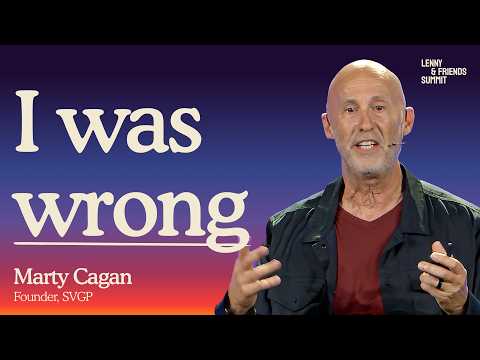
Marty Cagan: Strong Opinions, loosely held
- Length
- 22 min
- Language
- English
- Text from
- the video's captions
- Transcribed
- 2 October 2026
Summary
Marty Cagan delivers a talk at a Lenny's Podcast event about his top 10 regrets regarding his own product content, starting from the 2008 first edition of Inspired. He covers understating business viability, over-emphasizing problem discovery, ignoring why customers churn, the dangers of predictability, politics, product leadership, corporate governance, competition, and the avoidance of thinking. He closes optimistic that AI makes the product model's principles more important and easier to practice than ever.
Key points
- Cagan identifies two kinds of product companies: the project model and the product model, with dramatically different definitions of the job.
- He completely understated business viability in the first edition of Inspired, which only covered value, usability, and feasibility risks.
- Problem discovery is important but easy; the real paid work is solution discovery, which is where innovation happens.
- The most important question teams fail to ask is why people are not using their product, which is the key to unlocking innovation.
- Roadmaps and PRDs are not the issue; the issue is whether you use them as an arrogant prediction or as a communication device after testing evidence.
- Empowered product teams need better management, not less, and product leadership providing context like product strategy is critical.
- Product in the open market is a full contact blood sport, and solutions must be dramatically better than the competition to get people to switch.
- Good product work is about thinking, and Cagan worries that process, frameworks, and now large language models will be used as a substitute for thinking.
Questions it answers
00:00Framing and purpose
Why did Marty Cagan revisit his long-held product principles?
He identifies two kinds of product companies, the project model and the product model, and says he spent decades arguing durable principles, so with AI he felt he had to re-examine everything, even things he was taught were sacred.
- Two kinds of product companies: project model and product model.
- He treats his content as his product and does weekly discovery with product teams.
- He picked his top 10 genuine regrets, drawing the line at the 2008 first edition of Inspired.
05:00Business viability
What did Cagan get wrong about business viability?
He completely understated business viability; the first edition of Inspired only listed value, usability, and feasibility risks. He attributes the blind spot to his career in developer tools, one of the few areas where a PM can get away with weak viability skills.
- Viability covers marketing, sales, service, legal, compliance, privacy, safety, and ethics.
- It is even harder for AI products.
- Going forward, holistic systems thinking about viability matters more than engineering knowledge.
08:29Discovery and the real why
How should product managers split their discovery effort?
Problem discovery is important but easy; the real work is solution discovery, where innovation happens. He also regrets not emphasizing the more important why: why people are not using your product, which most teams never ask.
- Products rarely fail from insufficient demand; better solutions reveal the problem was never the issue.
- Almost nobody follows up with churned users to ask why.
- Asking why people don't use the product is the key to unlocking innovation.
11:52Humility and predictability
What is the real problem with roadmaps and PRDs?
The desire for predictability is deeply rooted and at odds with humility, innovation, and outcomes. Roadmaps and PRDs are not going away; the issue is whether they express untested requirements or serve as communication devices after evidence has been gathered.
- Using a PRD as untested requirements is the project model and a root cause of failed products.
- A PRD backed by tested evidence is harmless and useful.
- Predictability is important but not worth trading off outcomes or trust.
15:19Politics, leadership, governance
What did Cagan miss about politics and product leadership?
He was naive to think good product work would carry the day; politics are in the fabric of every company. He also barely covered product leadership, so teams set up empowered product teams without realizing they need better management, context, and product strategy.
- Half of his recent content deals with politics, half with AI.
- Product strategy is a prioritized list of problems to be solved.
- Companies that ship great products can become targets for people with different motivations; he recommends Eric Ries's Incorruptible.
18:37Competition and thinking
Why does Cagan say product is harder than his books made it sound?
Product is a full contact blood sport: you must be dramatically better than the competition to get people to switch. He also underestimated how far people go to avoid thinking, craving process, frameworks, and predictability instead.
- He structured Inspired as people, process, and product, which he calls a big mistake.
- Elon Musk was right that process is used as a substitute for thinking in many companies.
- He worries large language models will be used as an alternative to thinking.
20:30Optimism and closing
Why is Cagan optimistic about the future of product?
Thanks to AI, more companies than ever understand the need for outcomes rather than output, and discovery is dramatically easier. He stresses the difference between building to learn (discovery) and building to earn (delivery), and says the principles of the product model have never been more important.
- Two kinds of building: building to learn and building to earn.
- The craft of product strategy and product discovery matters more than ever.
- He thanks Shri Doshi, Teresa Torres, and Lenny.
Notes
Context
- Marty Cagan spoke at an event hosted by Lenny, framing his talk around his regrets about his own content, drawing the line at the 2008 first edition of Inspired.
- He had already spent 25 years in product before writing that book, and some regrets are less than six months old.
- He observes two kinds of product company: the project model and the product model.
Regret 1: Business viability
- The most embarrassing regret: the first edition of Inspired only covered value, usability, and feasibility risks, with viability buried inside them.
- Viability means the customer will buy it and it works for the business: marketing, sales, service, legal, compliance, privacy, safety, ethics.
- He explains the blind spot came from working on developer tools and platforms, one of the few areas where a PM can get away with weak viability skills.
Regret 2: Problem vs solution discovery
- He over-weighted problem discovery; understanding the problem, who it's for, and success criteria is not very hard.
- Solution discovery is the essence of the job and where innovation happens.
- Products rarely fail from lack of demand; when a better solution appears, the problem was never the issue.
Regret 3: The more important why
- Beyond "why are we working on this problem," the critical question is why people are not using the product.
- He churns from many products and almost nobody follows up to ask why.
Regret 4: Humility and predictability
- Readers took "PM as CEO of the product" instead of humility: knowing and admitting what you don't know.
- The desire for predictability is deeply rooted in both product people and executives and is at odds with innovation and outcomes.
- Roadmaps and PRDs are not going away; the issue is whether they express untested requirements (project model) or communicate tested evidence (useful).
Regret 5-7: Politics, leadership, governance
- Politics are in the fabric of every company; half of his recent content deals with politics, half with AI.
- Inspired barely mentioned product leadership; empowered teams need better management, not less, with product strategy as prioritized problems to solve.
- Companies that improve shipping products can become targets for people with different motivations; he recommends Eric Ries's new book Incorruptible.
Regret 8-9: Competition and thinking
- Product is a full contact blood sport; solutions must be dramatically better than the competition to get people to switch.
- Good product work is about thinking; people crave process, frameworks, and predictability to avoid it, and he worries LLMs will be used the same way.
Optimism
- Thanks to AI, more companies understand outcomes over output, and discovery is dramatically easier.
- He stresses two kinds of building: building to learn (discovery) and building to earn (delivery).
- He thanks Shri Doshi, Teresa Torres, and Lenny.
Text from the video's own captions. Summary and notes written by AI from the transcript, so check anything important against the recording.
More from Lenny's Podcast
- Everyone’s shipping more. Does any of it matter? | Claire Vo
YouTube · 24 min
Recently transcribed
- Watch this if you constantly worry | Finding Freedom Podcast
Peter Crone · YouTube · 1 h 5 min
- Every Time You Try to Fix Yourself You Make It Worse.
Peter Crone · YouTube · 1 h 12 min
- 你家神明廳位子擺對了嗎_用風水讓生活更順風順水feat.徐玉蘭老師
科技仙姑實驗室 · YouTube · 53 min