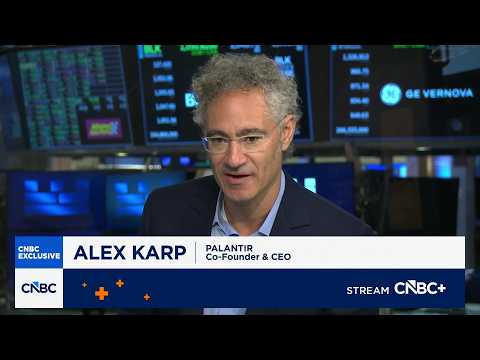
Alex Karp: AI Models Are Stealing Your Data & The AI Safety Truth | CNBC Full Interview
- Length
- 27 min
- Language
- English
- Text from
- the video's captions
- Transcribed
- 13 October 2026
Summary
In this CNBC interview, Palantir co-founder and CEO Alex Karp argues that closed AI models are effectively stealing companies' IP and alpha, which he says is driving a "sovereignty revolution" toward open-weight models and application layers. He claims that AI labs' talk of safety and regulation is really a push toward nationalization because their liability risk is unlimited. Karp also discusses battlefield AI, human-in-the-loop issues, competition with China, and the political backlash against AI wealth concentration.
Key points
- Karp says Palantir's commercial clients are livid because their IP and alpha are landing in closed models, effectively subsidizing competitors.
- He argues token prices on closed models are discounted so providers can access your IP to improve their models, without honest disclosure.
- Karp believes the safety-and-regulation debate is actually a push toward nationalizing AI companies because their liability risk is unlimited.
- He praises Dario Amodei as an ethical, shrewd business leader while disagreeing with his philosophical frame, which Karp ties to effective altruism.
- Karp warns that a revolution where he becomes 50 times wealthier while everyone else gains 10% will drive political insanity on the far right and far left.
- He says Palantir leads the application layer and the sovereignty movement, launched with Nvidia and Jensen Huang, and cannot scale to meet demand.
- On defense, Karp explains that offense requires a human in the loop but defense against peer adversaries may not allow time for one.
- He predicts enterprises will use multiple models, moving to open models where they have real secrets and alpha.
- Karp calls himself an actual progressive who agrees poor people don't get a fair shake, but disagrees that current proposals will help.
Questions it answers
00:00Client anger over IP theft
Why are Palantir's commercial clients so upset about AI models?
Karp says clients believe their alpha — their business ideas and data — is landing in closed models, so competitors get their IP while the clients paid for it. He describes them as livid, with one customer's mildest complaint being unprintable.
- Clients see closed models as stealing their alpha and data.
- Palantir claims to dominate the AI application space and US commercial.
02:01The sovereignty revolution
Why does Karp say closed model tokens are discounted?
He argues tokens are discounted so providers can access your IP to improve their models, not to grow the market, and that there was no honest disclosure. This is why the sovereignty movement, launched with Nvidia's Jensen Huang, favors open-weight models with an application layer.
- Token discounts are framed as payment for your IP.
- Open-weight models plus post-training are cheaper and safer in his view.
02:48Nationalization thesis
What does Karp think the AI safety debate is really about?
He believes the labs' philosophy — that they deserve all the world's IP — creates unlimited liability that only government can absorb, so the businesses must be nationalized. He ties this to the effective altruism movement and says investors who thought businesses were the mark are themselves the mark.
- Unlimited liability forces nationalization in his view.
- He attributes the underlying philosophy to EA (effective altruism).
05:45Wealth inequality and politics
How does Karp think AI wealth concentration affects politics?
He warns a revolution where he gets 50 times wealthier while others gain 10% drives political insanity, fueling the far right and far left. He opposes a wealth tax but supports taxing the very wealthy tied to cutting waste, fraud, and abuse.
- A wealth tax kills entrepreneurship, he argues.
- He calls himself an actual progressive who agrees poor people don't get a fair shake.
06:59China competition and safety
How does Karp view the US-China AI race and safety regulation?
He says the choice is binary — America provides the stack to the world or China does. On safety, he argues the first line of defense is liability for your own actions, and notes that seemingly everyone who understands AI is on some payroll, unlike the nuclear era.
- Europe has decided not to participate, in his telling.
- Regulators need knowledgeable people not on industry payrolls.
13:00Battlefield AI and human in the loop
How does Palantir handle AI safety in defense contexts?
Karp explains that battlefield systems concatenate classified data sets where no single component sees the others. Offense requires a human in the loop, but defense against a peer adversary may be too fast for one, raising hard questions about prediction and preemptive action.
- Different ethical standards apply to offense and defense.
- Karp says you ultimately have to pick a side between America and China.
17:33Battlefield performance and deterrence
Does Karp think AI battlefield performance deters adversaries like China?
He claims Ukraine, Israel, and America systemically outperform on the battlefield with these technologies, and that this would be a big concern in classified Chinese or Russian reports. He says it raises the threshold for aggression but decisions are multi-variable.
- He guarantees adversaries are concerned about Western battlefield AI.
- Domestic politics often drive timing of attacks.
23:09Palantir's growth and the future of models
What does Karp predict for enterprises and model choice?
He says Palantir is systemically undervalued, cannot scale to meet demand, and is stretched thin with about 3,600 to 4,500 people. He predicts enterprises will use multiple models — open where they have real secrets and alpha, closed for low-stakes uses like marketing.
- The sovereign movement demand exceeds Palantir's capacity.
- Open models win where enterprises hold real secrets.
Notes
AI Safety and IP Theft
- Karp frames the interview around Palantir's commercial clients being "livid" about what they see as theft of their alpha — their business ideas and data — landing in closed models and benefiting competitors.
- He argues closed model tokens are discounted not to grow the market, but so providers can access your IP to improve their models, with "functionally no honest conversation" or disclosure.
- The fix, in his view, is an application layer plus post-training on open-weight models, which he says is cheaper, safer, and lets you control your future.
Nationalization and Liability
- Karp claims the safety-versus-regulation framing is wrong. He believes labs' real position is that unlimited liability — to clients and to the world — can only be handled by government, so the businesses must be nationalized.
- He repeatedly invokes the poker lesson: if you think someone else is the mark, you're the mark — aimed at investors who cheered IP migration into companies they own.
- He expresses respect for Dario Amodei as ethical and shrewd, but ties his philosophical frame to the EA (effective altruism) movement.
Wealth, Politics, and China
- Karp warns you can't have a revolution where he becomes 50 times wealthier while everyone else gains 10% — it drives political insanity. He opposes a wealth tax but supports taxing the very wealthy tied to reducing waste, fraud, and abuse.
- On China, he says the choice is binary: America provides the stack to the world or China does. He doubts the US and China can agree on shared risk frameworks.
Palantir's Position
- Palantir leads the application layer, the sovereignty movement (launched with Nvidia and Jensen Huang), and battlefield AI. US commercial grew 149%.
- On defense, offense requires a human in the loop; defense against a peer adversary may not allow time for one.
- He predicts enterprises will use multiple models — open where they have real secrets and alpha, closed for low-stakes uses like marketing.
Text from the video's own captions. Summary and notes written by AI from the transcript, so check anything important against the recording.
More from Vampyre Drakul
Recently transcribed
- The Media Game Has Changed
a16z · YouTube · 41 min