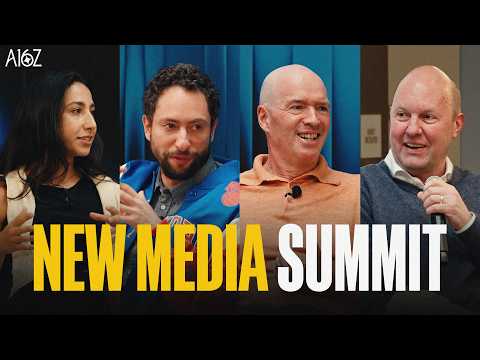
The Media Game Has Changed
- By
- a16z
- Length
- 41 min
- Language
- English
- Text from
- the video's captions
- Transcribed
- 13 October 2026
Summary
Ben Horowitz, Marc Andreessen and Gabby from a16z discuss how the rules of media have fundamentally changed. They argue that legacy media has become agenda-driven and no longer offers a path to favorable coverage, so founders must go direct and build their own brand. The brand is now the person, not the company, and success requires being authentic, interesting, and willing to be loved and hated.
Key points
- Old media had restricted channels and formats with companies as brands; new media has unlimited channels and the brand is now the person.
- Marc's media trainer Les Elden advised saying in public what you would say at lunch with a friend, and answering your own questions instead of the interviewer's.
- After 2017, legacy media became agenda-driven, and Marc tells founders there is no way to get a story they'll like through traditional media anymore.
- Corporate brands arose in the 1930s-40s because centralized media forced messages through narrow channels; as that world collapses, person-as-brand returns.
- Ben says responding to small anonymous critics is a waste of time, but a real attack that lands is an opportunity to boost your brand.
- Marc says you want people to both love and hate you; being neutral or lukewarm makes you uninteresting.
- Gabby's advice: get the message right before investing in distribution, and start with the outcome you want rather than everything you could say.
- Think outside in: find the most interesting story in the world and plug your company into it, as Alex Karp and Ryan Peterson do.
Questions it answers
00:00Authenticity over media training
Why is authenticity the first rule of new media?
Marc recounts being trained by Les Elden, a former 60 Minutes producer, who told him to say in public what he would say at lunch with a friend. If you know your topic intimately, you should be able to talk about it in a viscerally interesting way, and you can refuse bad questions and substitute your own.
- Old media training produced 'plastic people' who avoided controversy
- Les Elden's advice: talk like you would at lunch with a friend
- Answer your own questions instead of the interviewer's bad ones
06:58Old media is defense, new media is offense
Why did traditional media stop working for founders?
Marc says the press's 'speak truth to power' mission devolved into 'power to truth' and became agenda-driven, especially after 2017. He tells founders there is no way to get a story you'll like through traditional media anymore, so the new approach is going direct and using new media.
- Legacy press had two missions: objective journalism and speaking truth to power
- The second mission swamped the first around 2017
- The new approach is go direct plus new voices in new media
12:15The brand is the person
Do founders have to become the face of their company?
Ben explains that in new media the brand is the person, citing Elon, Alex Karp and Palmer Luckey. It has to be a permanent person tied to the organization; it can be someone other than the CEO, like Marc is for a16z, but not a VP of marketing on a three-year run.
- Old media: restricted channels, restricted formats, company brands
- New media: unlimited formats, unlimited channels, person as brand
- The brand person must be a permanent fixture, not a short-term marketing hire
16:00Centralized media created corporate brands
Why did corporate brands replace personal ones?
Marc traces corporate branding to the 1930s-40s rise of centralized media, which forced messages through narrow channels like three TV networks. As centralized media collapses, the person-as-brand model returns, exemplified by candidates now needing to go on Joe Rogan for three hours.
- Before the 1930s companies were named after people
- Centralized media forced messages through a narrow straw
- Presidential candidates now must be able to do three hours on Rogan
20:10When to fight back
When should you respond to criticism publicly?
Ben says responding to small anonymous accounts is a waste of time, but a real attack that lands is an opportunity to boost your brand, like his Instagram response to The New York Times. Marc adds you want people to both love and hate you; being lukewarm means you're uninteresting.
- Don't respond to anonymous accounts with no audience
- Real attacks are opportunities to boost your brand
- Being hated means you made a mark; being neutral is uninteresting
24:50Building the new media team
Who should you hire for new media?
Marc warns that people trained in old media struggle to transition because everything about the game is opposite. Look for people who have actually built an audience and can tell a story end-to-end; Ben adds that storytelling is the real skill, and a team of multiple good storytellers is a huge power boost.
- Old media experience is 'opposite world' and hard to unlearn
- Hire people who have actually built an audience
- Storytelling is the elite skill; many old marketers lack it
30:00Common founder mistakes
What mistakes do CEOs make going direct?
Gabby says founders over-index on distribution and tactics before getting the message right, and they focus on inputs rather than outcomes. Start with the outcome you want, work backwards to what your audience needs to believe, then pair the right message with powerful distribution.
- Distribution is a multiplier on the message; fix the message first
- Start with the outcome you want, not everything you could say
- The team must be invested in the message, not just distribution
33:40Think outside in
How should founders frame their story?
Marc says the default inside-out story is boring and undifferentiated. Instead, find the most interesting thing happening in the world and relate it to your company, as Alex Karp and Ryan Peterson of Flexport do. Ben notes this skill can be learned and developed over time.
- Your startup story is not inherently interesting
- Find the most interesting story in the world and plug your company into it
- This skill can be developed, as with Alex Karp and Donald Trump
Notes
The New Rules of Media
- Old media had restricted channels and formats with companies as brands; new media has unlimited formats and channels, and the brand is now the person (Elon, Alex Karp, Palmer Luckey).
- Old media is defense-oriented; new media is offense.
- The one rule of old media was "don't be interesting" — the worst thing you could do. New media requires being interesting or you get drowned out.
Authenticity
- Marc's media trainer Les Elden, a former 60 Minutes producer, told him to say in public what he would say at lunch with a friend.
- If you don't know a topic inside out, you shouldn't be talking about it. If you do, you should be able to talk about it viscerally and interestingly.
- The "pivot": answer your own questions instead of the interviewer's bad ones.
- Classic media training made CEOs into "plastic people" who measured success by minimum controversy.
Why Legacy Media Stopped Working
- The press had two missions: objective journalism and speaking truth to power. The second devolved into "power to truth" — intimidation — and swamped the first, especially after 2017.
- Marc's advice to founders: there is no way to get a story you'll like through traditional media anymore.
- The new approach has two parts: go direct (tell your own story through your own channels) and new voices in new media.
- Even Washington insiders now read the Mark Halperin newsletter, not just legacy outlets.
Why the Brand Is the Person
- Before the 1930s, companies were named after people (Ford Motor Company, Edison Electric). Centralized media (three TV networks, a few big papers) forced messages through a narrow straw, creating abstract corporate brands.
- As centralized media collapses, person-as-brand returns. After 2024, presidential candidates must be able to do three hours on Joe Rogan.
- The brand person must be permanent — not a VP of marketing on a three-year run.
Fighting Back
- Don't respond to anonymous accounts with 50 followers — you're amplifying people with no audience.
- A real attack that lands is an opportunity; Ben's Instagram response to The New York Times was his biggest post at the time.
- You want people to love you AND hate you. Being lukewarm means you're uninteresting. When you get big, people hate you — that means you made a mark.
Building the Team
- People trained in old media live in "opposite world" and rarely transition successfully.
- Hire people who have actually built an audience and can tell a story end-to-end. Storytelling is the elite skill.
- The team must be invested in the message, not just distribution.
Founder Mistakes and Outside-In Thinking
- Don't over-index on distribution before getting the message right — distribution is a multiplier on the message.
- Start with the outcome you want (which customer, which hire), then work backwards to the message.
- Think outside in: find the most interesting thing happening in the world and relate it to your company. Alex Karp never talks about Palantir; Ryan Peterson talked about the global supply chain collapsing during COVID, not freight.
- This is a learnable skill — even Alex Karp's and Donald Trump's old interviews were very different from their current style.
Text from the video's own captions. Summary and notes written by AI from the transcript, so check anything important against the recording.
More from a16z
- Marc Andreessen’s Worldview in 60 Minutes | Live on MTS
YouTube · 1 h 6 min
- Why Physical AI Is the Next Frontier | Applied Intuition with a16z
YouTube · 1 h 20 min
- OpenAI President on What it Means to Cross Into The Age of AGI
YouTube · 49 min
- Marc Andreessen & Amjad Masad on “Good Enough” AI, AGI, and the End of Coding
YouTube · 1 h 12 min
- Marc Andreessen on the State of Film and Hollywood
YouTube · 1 h 8 min