Full transcript
Alex Karp: AI Models Are Stealing Your Data & The AI Safety Truth | CNBC Full Interview
AI safety warnings and client anger over IP theft
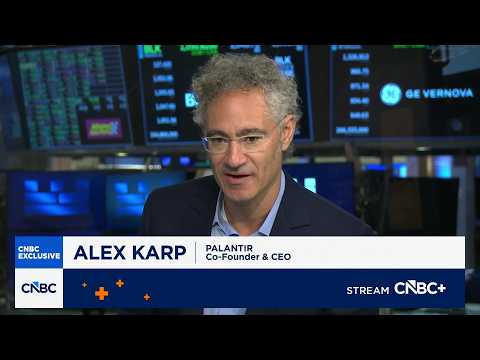
00:00It's a risk our next guest has been warning the tech industry about for months. His company writing in June, "Your AI sovereignty dictates your institution's future." Here with us now at Post 9 in a CNBC exclusive interview with Palantir [music] co-founder and CEO Alex Karp. Welcome back. It's good to see you. >> Delighted to be here. You know, I've been here many times with you. And you guys are tough, but among my favorites. >> Okay, well, thank you. >> uh >> Well, we're excited to talk to you because this is a really important week. And there's been this explosion of AI safety warnings. Where do you stand on all of it? >> so okay, Palantir we've been we've been in the forefront of using AI
00:38in the military context, the first company to build actually a functional AI technology. As is currently well known, we're dominating the application space. We have a product. So, there's a lot of we have a lot of experience with like what works, what doesn't. There are really different kinds of safety issues, quite frankly. Um almost all my we dominate US commercial as a company, and the clients, our partners, are livid at this kind of safety they're most upset about. What they believe is the theft of their alpha, meaning their ideas about how to run a business, their data, it landing in a model, and they find out that the the competitor next door has all their alpha, meaning how they do their business, and they paid for it. I
01:21mean, I can't repeat what the customers are saying, but they're basically like one to give you the one that was the least vulgar, it's like, but but how can they tell me not to wear a condom? Like, this is This is And that's the least vulgar person that we deal with. They're like livid. And so, they're livid. So, that's >> Wait, what? Can you just like translate what you're talking about? So, is this because of the LLM's fault they're sharing >> No, no. Open The reason why the sovereignty revolution, which we helped launch together with our our partner Jensen Huang, the in famous founder and head of Nvidia is uh um the when you use a closed model and you pay for tokens, you're not The reason the tokens are discounted is not so they
The sovereignty revolution and closed model economics
02:07can grow the market. It They're discounted so that they can get access to your IP so that their models get better. And there was functionally no honest conversation about this or disclosure. Now, that's point one. Point two is without an application layer and without post training, which is currently being done with open way models, you in the classified side and it's just taking off across America cuz it's cheaper and ends up being safer and you control your future and your present. Um you are de facto outsourcing the value in there. By the way, it's very much linked to the safety concerns. Now, Dario is one of the most important entrepreneurs. I've been at this for a long time. I've never seen anyone come
Dario Amodei, effective altruism, and nationalization
02:48from the back >> you like him. >> I I have a lot of respect for him. And I have a lot of respect for him because he's actually believes of course he's a business person to most sometimes. So, of course when the company's not doing as well, these things come forward and then they talk about safety and when it's doing better, they they they I I I don't think that's actually what's driving this, but you know, I mean it does happen regularly. But I think the you know, he's what makes him so strong is he's ethical and a business person. Okay, so um but but but what's actually happening is very different than what people are reporting. Everyone thinks this is a safety versus non-safety versus regulation. What What What he I believe
03:28is realized is it if you if take the a philosophical frame they have which is we are deserving of having all the IP in the world, we the thousand people who think the way we do, uh that's why you can't work with the military. That's why you can take the IP from businesses and put it in your model. That That model would require severe liability protection. And there's only one institution that can do that, the US government. And then that's before you get to the danger. So, what was really happening is the investors loved when he was migrating all the value of everyone else's business to their business cuz they're investors. They don't realize it's like it's like every mark. They don't realize they're
04:11the mark because now you first you migrate all the IP to your business and then because you would need uncap you need cap liability both vis-a-vis the business and vis-a-vis the dangers, you've got to migrate the business to the government. It has to be nationalized. So, what's actually happening is this is reported as regulation non-regulation movement. That's actually not what this movement is. It's like the view that I believe they have is these businesses have to be nationalized because if you don't nationalize them, every single one of my clients is going to sue. >> That you think that's what they want? >> Well, obviously, like if you have a business that presupposes unlimited risk both vis-a-vis liability risk vis-a-vis
04:50the clients cuz I don't think any of our clients realize their IP was migrating. Vis-a-vis the world because you're saying what is the liability risk for destroying 10% of the company? 10% of the world. It's discounted into the present. Okay, but there's only one institution. And by the way, that's not actually what's happening. They want three institutions. It's going to be like Europe, Canada, and America. We migrate all the IP of America from our businesses to this institution. Then the institution is going to get full liability protection because it's nationalized. >> think Open AI wants this and what about this? >> very No, I think I think these are very different things, but I think that is
05:25the core philosophy of the EA movement imposed upon a business. >> EA effective altruism. >> so that's actually what is driving this. Now, of course, the other model companies have very different I think what most what what they want is and I think is we first we should self-regulate. If you do not self-responsibly self-regulate. By the way, though, the biggest danger currently of this revolution is that it generates inescapably I think it will raise the votes of most people but you can't have a revolution where I become 50 times wealthier and everyone else becomes 10% wealthier. It's going to drive political insanity. Political insanity, what does that look like? It looks like obviously wealthy people should pay more than fair
Wealth inequality and political insanity
06:06their their share of the taxes but a wealth tax kills entrepreneurship. It actually is it by the way it's massively beneficial to me. >> How do you share the benefits? >> So you have to find ways to actually tax at the high end that that aren't a wealth tax. There are ways to do this. I think the way you do it is you tie reduction of waste fraud and abuse to increase taxes among the very wealthy. So but in any case you you have to you you the other political insanity and then realize the financial thing is look at the far right and far left in this country. This is directly tied to the fact that many people are like screw this. I don't want these people becoming a hundred times wealthier. I'm going to
06:44blow up the whole system. What does that blowing up the whole system looks like? It looks like DSA people who are very happy to talk about how they're not anti-Jewish. They love that. They don't like to talk about how they're not anti-black cuz that's something they hide. You have the far right. It's like everything is a data center run by somebody. It's like they attack us for running data. We don't even build data centers. [laughter] We get attacked. So that is like and by the way the one of the biggest mistakes the labs have made is we are in competition with China. Some people think they're enemies. Some people think they're competitors. Pick your spectrum. Either we are going to win and provide
Competition with China and the AI stack
07:19the stack to the world and stack doesn't mean you have to take the whole part or if they're going to win. And that means the the danger is not just a danger of dangerous things happening to humanity which by the way what business isn't responsible for minding your own safety? You can't go to a what you know another reason our customers are livid is like they build chemicals >> a whole new frontier, right? When they're talking about the safety of humanity and creating a technology and AI that can break free this misalignment from human intention and then do really bad stuff to us. I mean, that's a societal issue, isn't it? >> Of course it's a societal issue, but you >> You think they can self-regulate that?
Liability, self-regulation, and the S-1 question
07:57>> Well, you have to find a way to set reasonable guidelines that are enforced, but you can't do it. The first line of defense is you're liable for your own actions. So, it's it's a weird twist. They're asking for societal regulation to get out of the first line of defense, which is if you build a technology that can destroy 10% of the of of of the world. That is a that has civil and criminal liability attached to it. The first step is to say, "Okay, it is not The first step isn't to say we get out of it because we want to self-regulate or we want regulation." The first step is to say, "Okay, you've disclosed this. What are you doing about it?" >> Right. >> And the second step is to say, "If you're not doing any you're not being
08:35responsible, we're we're going to have to get people involved." That's going to be also very complicated because regulating these things need people. You need people who understand them. Another problem we have is seemingly everyone who understands this is on some payroll. So, it's like, you know, it's like who you're going to trust? You know, when we built nuclear energy, we built the bomb. People did it because they believed. They were not on the payroll. >> Um this the liability that you're talking about, how does that get written into the S-1? What do risk factors sound like? >> This is the thing. You're assuming that there will be an S-1. Now, I don't Okay, maybe there will be. The only way to
09:09deal with this kind of liability is to go to the government and say, "Nationalize us, please." You know, a lot of times in business people don't say what they want. They're leading you to the conclusion. The reason why people don't have not understood this is again, every investor, and there are a lot of people who think they're going to make money. They're like, "Oh, the businesses are the mark." What is the first lesson in poker and in life? If you you you think the other person's the mark, you're the mark. You are the mark. And it will be nationalized simply because of the liability issues they're talking about. >> the Trump administration's going to get on board with that? >> I don't know what they're going to do,
09:47and I think that's probably a barrier to entry, but it it's like you can delay it. You have to There's only one When you have unlimited liability, the only way to deal with it would be to go to the government and say, "We'll give you 50% of our business." Of course, the value of the business will collapse first when you do that, collapse another time when you have people on the board, collapse another time. All of us might even collapse the whole market, but you That is the way you essentially But again, you have to look at the philosophy of it. Again, this is where the investors have just made such a big mistake with their greed. Like, a little bit of greed is great, but like it's like No, they didn't mind when the when
10:21the when the IP is being migrated from every business to an entity they own. But the next step is obviously to take that value and migrate it to the government. But oh, that would never happen to me. And like And again, this is where I have tremendous respect for people like that because he's thinking ethically according to his ethical frame. He's not thinking primarily financially. This is what's made him such a great business leader. This is the reason why the best engineers researchers want to work for him. It's the reason why he came from fifth behind to number one. This is a very, very smart, shrewd, ethical person. The ethical frame is different than the frame most of us have, which is we need
11:02to share wealth, we need to expand the wealth, we need to diverse put more diversity in terms of who owns and who regulates and who controls and if it started in America, it could have only been built in America, only America would have allowed you to buy it, only America provided the regulatory framework where this could have happened. America should be the final arbiter of it in the military and in regulation, and that's exactly what they do not want. >> It sounds like you think his examples of potential harm, right, disabling the internet, You think those are in the realm of the possible. You're not disputing any of that. >> I I'm I'm What I'm saying is if I let's just take nuclear energy.
11:40There it's very like for example, one of the reasons France is still much stronger than you'd expect is they moved to nuclear. If you look interestingly, if you look at energy expenditure per unit per person as a function of GDP, it's America, China, uh Israel, and then Switzerland, roughly France. Okay. So, this is very This is technology that is sharp. It's used in medicine. It's used in nuclear. It powers our deterrents above the air, below the air, in the ocean. Okay. It It can also be abused, and there are also accidents. The first step, you cannot say I'm building something, but I have no idea how to bound it. And I don't believe that's what But again, that's I don't believe that's what they're saying.
12:24>> That's not what they're saying. >> No. No. No. That's what they're saying, but that's not what they mean. >> Right. >> What they mean is the obvious solution is America America gives a risk essentially limits the risk in return for owning it. Or a national or multinational government does. That's what they actually mean. That's not what they're saying. Because you couldn't come out to say it cuz somebody has It's like two It's like the investors are going to be what the F? I thought someone else was the mark. >> [laughter] >> Right. >> I'm counting my huge pile of pennies. >> for marketing an IPO. >> Well, it Yeah, I mean, you know, people don't like finding out they're the mark. But again, the way you The way you can
Palantir's application layer and battlefield AI
13:00avoid being in a mark in in life is to assume when someone is pointing out someone else is the sucker, you're the sucker. >> What So, you have I mean, for people don't realize like Palantir, you're kind of the the in between, right? Those frontier models and then the enterprise >> You can think of it as you There's something called an application layer. Historically, the reason we thrived even before people realized the safety issue was this big was that to make these models actually work precisely over very complex use cases, think building complicated manufacturing, Nvidia's >> at Chipotle. >> Food safety, uh military, Nvidia's supply chain, things that are very proprietary and need precision where you
13:42own the precision, you need an application layer. And the application layer also allows you to use models that might otherwise not be safe, like closed models that may in fact be migrating your IP to them. >> Right. So, what I was going to ask is you do a lot of this for the federal government and for the defense department. And so, you have experience in >> Well, our we are the single most enterprise software company, I believe, in the world. In the US, it grew 149%. We are famous for what we do on the battlefield. And on the battlefield, you have exactly these issues. >> Exactly. That's where I'm going. Like, you can't make these safety mistakes when you're talking about using AI in the workforce.
14:17>> you have you Look, you you you're always in the business of reducing things beyond what we could do yesterday in safety and in positive and negative. The thing that's very important about the battlefield base, first of all, you are you may or not may not You can help bring our men and women home. So, there's like the safety thing. Then, there's the precision of what happens. And then, very interestingly, national security is different technically than people think. There's like even inside an enterprise, there are multiple levels of security. So, like, for example, you have levels of classification. But then, there are classifications that you need to be classified to understand. So, when you're on the battlefield, you're
14:57working at when the when a missile lands on our enemy's head, it actually is the concatenation of data sets and precision that's owned in our anthology and in the model they use, where no single component would be able to see the other component. So, it ends up being But by the way, you have very similar issues with like a supply chain at Nvidia or food safety >> what I'm wondering is how do you make sure that that's determined by a human and not by the AI. Cuz that's some of the Some some say it's science fiction, but that's what some of the worry is. >> the human in the loop thing is a very, very big issue. We have powered human in the loop. The com- complication in defense is you have different ethical
Human in the loop and offense vs. defense
15:35standards for offense and defense. So, like if I'm attacking you, I have to do I'm only allowed to do X things if you're attacking me. So, the problem in this context is if someone is if if like we're peer-to-peer adversary, you're going to have to have a response that is not a human in the loop. It's so quick. And and also with this kind of technology, you can often predict. So, if we can predict you're going to you're going to attack me, is that offense or defense? Because in offense, you definitely need a human in the loop. In defense, there's going to be no time. Okay, what if I can predict in in 35 seconds or in 3 hours you're going to attack me? Is that offense or defense? And so, there there there a lot of The
16:12reason why you really, unfortunately, many of my academic colleagues don't want to hear this, you really have to pick a side because in the end, America in all its greatness is not is a country and we're not perfect, but we are great. It is a decision. And by the way, I've spent half my life studying Chinese culture. I I'm a very high-level practitioner of of Tai Chi, one of the four great treasures. I mean, no way is it xenophobic toward China. I I have great admiration for it's like the one of the oldest, most productive cultures in the world. I mean, I can give you long lectures on this, but in the end, there's a choice. Europe has decided to not participate. Israel was small. Where is a choice? Is it us making these
US-China framework and battlefield performance
16:51very hard decisions that will be imperfect, or is it them? So, next week when she and the president meet, can they agree on some shared risks? I I mean, I would love it if it happened. I think it is unlikely we're going to The problem is we're we're we're tight enough as competitors that both sides believe they could win. And so, I I would Look, I would love it to happen. I'm not in that room. I I would If it happened that we'd all be happier Palantir we'd be happier. Um if you could have some kind of framework where the two dominant countries could control it that would change the world. I would be surprised if it happened. >> I was going to ask your perspective on on some of these on the wars. I mean you
17:33have said and you have said we have the best technology and we have the we're winning the AI race and we have companies like Palantir working on it and yet you know Ukraine war, Iran war we're kind of in these in these stuck places right now. >> Um you know when you're talking about battlefield performance where the Ukraine's a good example. Every day when I got there day five there was not a single person who didn't think they were going to lose. Like so you have always have to look what what happened against expectations and that the countries that are in the west that are are are wield these technologies are Ukraine, Israel and America. I guarantee you if you got a classified report of from the from China
18:10or Russia one of their biggest concerns would be the systemic outperformance of these countries on the battlefield where these technologies have been implemented. Guarantee. In fact, you know, as far as is possible for me to know that without knowing it cuz I don't interact with those countries I can tell you this is true. >> You think that deters them from Taiwan or something else? >> Look, there are a lot of variables that go into these decisions. They they the the diagnostic of America and its capabilities on the battlefield it means that if they believe we were actually to use them it's just a much higher threshold. But you know, I mean like these things are not as like these are multi-variable
18:50equations and also quite frankly often have to do with domestic things that we often overlook. Like where when you attack may just have to do with like what is your stature at home? >> So is there anything if you saw it in in the models that they were doing in these AI companies where you would where that would that would freak you out and say we can't like we have to draw the line and we can't use this. >> It's it's it's it's this is a situation where we all need to First of all, we need to get serious. You know, we're talking about like we like I'm always telling people in different contexts, you know, there is a rule here for every every single business person looking at the show, every single business that's listed or
Business anger, liability rules, and Dario's real message
19:29not listed has a set of rules. It's called I deliver products that are where I do not deliver them if I believe in it to be harmful. You just have to start there. And again, I I think the discussion that we're having is not what this is about. the discussion we're having is I want to do things. I want new rules for myself and I don't want to pay the cost true cost of that, which is caught liability, primarily civil, but potentially obviously criminal. And that every single This is why the business people I mean, I talk to business people every day. I've never seen them this angry. Like it's like and every conversation's like this. Wait a minute. They got my IP. They want to play by rules I don't play
20:08by, whether that's a hospital service, doctors, real estate. Every single business person in the country worries every day about doing something that they didn't even know was harmful. Forget knowing it was harmful. You You can ruin your business with something I know it's crazy. Like you find out there's something in your product you had you did your absolute best to keep out of it out of the product. You you still can be found liable. Like you think the plaintiff's attorneys are running up there saying, oh, oh, gee whiz. >> You didn't mean it. You didn't mean it. >> No, you're paying your billions of dollars. You lose your house. You lose your future. >> So they face lot So they >> No, I'm just I'm just saying you can't
20:51change the rule book, but but again, I don't actually do not underestimate Dario's talent. He That's not That's not what he's actually saying. What he's actually saying is this technology is so unique, it can only be harnessed in a multi jurisdictional, meaning more than one country, and I can only do it if you if I get to transfer all liability concerns within a million up to a million dollars to the US government and probably European and Canadian governments will be the fantasy. And in return [clears throat] >> But even Elon Musk was sort of like in agreement with that. >> Look, I I can't comment on what everyone's saying. I'm just telling you what's happening. I don't I don't know like I don't you know, we're down we
21:29have this massively growing business. I I barely get time for air. I'm It's like [laughter] we're building our products. We're we are going to own anthology in North fine-tuning the models, fine-tuning the open weight models, controlling the sovereign movement was primarily launched by us and Nvidia and like it's just like it's like it's like you're a rock band. I have these huge stadiums of people who want their sovereignty. So, I'm just telling people and I also >> high valuation on your stock. Do you think the market doesn't appreciate this? >> I I I look, I mean we are obviously so systemically undervalued. But it's okay. It's because people are Look, investors first of all, investors really did fall
22:11for I'm going to make a ton of money. There's no liability. It's all upside. All the alpha goes to them and therefore every bit of value of business is okay, great. Then these are very technical things. What does it mean to be sovereign? What does it mean to train a model? Are the Are the Like you have to The more you go into the granular details of our business and like how everybody wants to do it. The mere fact the sovereign movement is so much bigger. We need partners. We we cannot scale into our US market. I have people calling me from like very important allies and I'm like, "Look, we can't deploy." I can't take someone out of the US market. Like these are like crucial deployments where honestly we have the
22:47only thing that works. But it's like What are we going to do? >> Capacity? You just there's so much demand. >> It's like we we have we're mildly 4,500 We're basically Think of it like every company. 3,600 people are the We're I would say are the best obviously the best in the world. Um and we're just we like every single one of them has like I have one guy from England. Like I literally to get the job done, I have like okay, just pretend you're three people work around the clock. I'll pay you for it. There's no other way to do it. >> Why? Cuz you can't find enough good people? >> Well, it's I mean it's like hiring and training people to be full Palantirians is is a is a process and the market is expanding way beyond the
Palantir's growth, capacity limits, and valuation
23:30way what we can do. And so yeah, the market is expanding because like if you want to talk about customer demand, every single person I deal with is either on the sovereign thing or wants to be on it or even skeptics, you literally talk to them five seconds, you're like well, how do you feel about this and this? And they're like oh wow. It's like it's everywhere. And the depth of passion around this in enterprises like I've been at this for 20 years. I've been I was we we led the we led the anti-terror revolution, we led the the defense tech revolution, we led with Foundry like products that work revolution, especially in the US. We led the application layer, we're the first to do the sovereign thing and like and
24:12I've never seen anything like this. Like every single minute you're not in this country, you are losing money. >> Really quick, before we let you go, on on Dario as an example, what are the odds that that model, his model, doesn't survive? And what are the implications for stocks and everything else if it doesn't? >> I look, I don't like I I I I think he is a one of the great legends in tech and business and I'm not wishing them not to survive. I think obviously everyone's going to move to only using their product and application layer, that's good for them because and it's obviously better for us, but we were right. Um and the future is going to be enterprises using multiple models, some open, some
Open vs. closed models and the politics of AI
24:57closed. Prefer They're going to really where you have actual secrets and alpha, they're all going to move to open models. And where it's like marketing in Argentina, and the person wants to use a closed model, they'll do that. >> I just say I wonder about the politics of all of this. Bernie Sanders wants to now ban super intelligence. Elizabeth Warren also is calling for a pause >> It's not just the left. We have to be like, you know, I look I It's It's It's It the far right and far left. First of all, they're right about the unpopularity both of the movement and of the people. And they're taking advantage of the fact that the the the present presentation of the technology by the people doing it
25:38could not be worse. So, like my Honestly, if you want to take the far right and the far left, you can't hate the player because they understand the game. >> shock doc day. >> They They They They're just monetizing. They understand the political landscape. Are they right? No, but are there elements and truth in what they're saying? Of course. They're abusing elements of truth, but the core truth that they understand is you guys have wrecked yourself as if you do not have the sense God gave a goat. You are unlikable and you're going to be 50 times richer and we're not down for it. Then, the solutions are only going to help our adversaries. But again, it's not just Bernie Sanders and Liz Warren or whatever. These are people By the
26:14way, I happen to If you're listening, I agree with you guys on a lot of issues. Poor people in this country do not get a fair shake. That's true and I'm not certain that they're going to get that much of a better shake in 5 or 6 years. We agree. >> calling yourself a liberal progressive, Alex? >> I am an actual progressive. Actual progressives want poor people, working class people to to have better lives. What I disagree with them on is that this isn't going to help. But again, you can't go to the player and say, "You created the game. I'm not going to monetize it." They're absolutely doing what they need to do. We need to do a better job of doing what we need to do. >> Which is talking about how the benefits
26:53>> again and in any case thank you very much. >> Vampire Dracula here. If you found value in this video, please smash the like button. Let me know your favorite part of the video by commenting below. And most importantly, don't forget to subscribe and ding that bell. Until next time, keep it real.