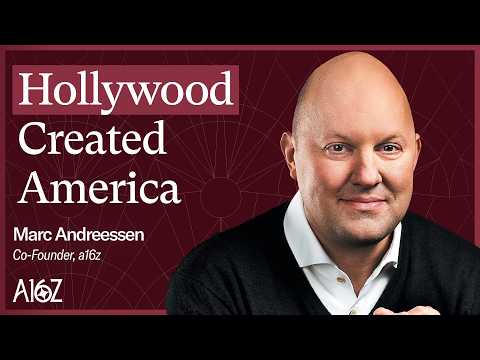
Marc Andreessen: How Movies Explain America
- By
- a16z
- Length
- 1 h 16 min
- Language
- English
- Text from
- the video's captions
- Transcribed
- 14 October 2026
Summary
In this a16z conversation, Marc Andreessen and his co-hosts discuss movies that explain America: Once Upon a Time in Hollywood, Tropic Thunder, Oppenheimer, and Fight Club. Andreessen argues that Once Upon a Time in Hollywood captures 1969 as the pivot when the 1960s cultural revolution turned dark, and that Tarantino's counterfactual ending is a love letter to a better America. He contends that Tropic Thunder is the best Vietnam and Hollywood film ever made, that Oppenheimer's morality is upside down with Lewis Strauss as the true hero, and that Fight Club has flipped from a left-wing to a right-wing reading since 1999. Throughout, the speakers draw parallels between the 1960s cultural revolution and America's political trajectory over the last decade.
Key points
- Marc Andreessen argues that movies about Hollywood, when they reach capital-A art, become movies about America, and LA is the archetypal American city built as a land development deal out of desert.
- He reads Once Upon a Time in Hollywood as capturing 1969, the pivot point when the 1960s cultural revolution turned dark after the Manson murders.
- Tarantino's film is a counterfactual love letter in which the Manson killers pick the wrong house, meeting Cliff Booth (the most deadly man in the world) and Rick Dalton's flamethrower.
- The speakers draw an analogy between the 1964–1972 cultural revolution and America's own recent decade, which they say ran from roughly 2014–2015 to November 2024.
- They call Tropic Thunder the best Vietnam war film and the best Hollywood film ever made, noting Robert Downey Jr.'s blackface role earned him an Oscar nomination.
- Marc argues Oppenheimer's morality is upside down: Lewis Strauss was the hero, the security concerns were legitimate because Soviet spies did steal the bomb, and mutually assured destruction prevented World War III.
- He criticizes the film for presenting Einstein as a moral authority when he says Einstein was pro-Stalin.
- Fight Club was intended as a left-wing anti-capitalist movie in 1999 but reads as an ultra right-wing movie today, and Marc considers it capital-A art that will be discussed 100 years from now.
Questions it answers
00:00Hollywood movies as American stories
Why does Marc Andreessen love movies about Hollywood?
Because insiders making them know where all the bodies are buried, and LA itself is the archetypal American city — a fake-it-until-you-make-it land development deal carved out of desert, whose water saga became Chinatown.
- Recommended Hollywood movies: Mahal and Drive, The Player, Sunset Boulevard.
- LA was sold via newspaper ads with line drawings of orchards that didn't exist.
04:281969 as the turning point
What historical moment does Once Upon a Time in Hollywood capture?
It captures 1969, the pivot when the 1960s cultural revolution — which began around 1964 with the Berkeley free speech movement — turned dark after the Manson murders, beginning the slide into the 1970s.
- The Manson murders were the moment America realized the counterculture had a dark side.
- The film is a counterfactual in which the killers pick the wrong house.
11:24The counterfactual and the Tate family
How did Tarantino get the Tate family on board?
Sharon Tate's family initially objected, but after reading the script they completely approved. The film becomes a Valentine to Hollywood and to Sharon Tate, restoring her memory, with the flamethrower Easter egg from Inglourious Basters signaling a revenge-fantasy direction.
- Cliff Booth is conceived as the most deadly man in the world — a super-decorated war hero turned stuntman.
- The 11-year-old co-star represents Jodie Foster and the naturalistic "new Hollywood" acting style.
- Audiences laughed through the 20-minute violent finale; the novelization confirms Cliff killed his wife.
32:48Parallels to the present
What parallel do the speakers draw to today?
He sees a direct analogy between 1964–1972 (ending with Nixon's 49-state landslide re-election) and the last decade, which he dates from roughly 2014–2015 to November 2024 — a cultural revolution that ended and left people thrilled or horrified.
- Whichever side you're on, today's world is darker than people expected.
- The echoes are profound though not exactly comparable.
34:50Tropic Thunder
Why is Tropic Thunder considered the best Vietnam war film?
They call it the best Vietnam war film and best Hollywood film ever made — a 2008 satire starring Robert Downey Jr. in blackface as a method actor, Tom Cruise as Les Grossman, and marketing stunts like the real Booty Sweat drink and an Oscar petition that got RDJ nominated.
- Disability advocates were the most upset group in 2008 over "Simple Jack".
- The film could not have been made during the last ~13 years of the cultural moment.
- Tom Cruise's role was his career recovery after bad publicity.
49:40Oppenheimer's upside-down morality
What is Marc's critique of Oppenheimer?
He says the film's morality is upside down: Lewis Strauss was the hero, the security concerns were legitimate because Soviet spies did steal the bomb's wiring for Stalin, and Einstein — a Stalinist — was no moral authority. The nukes' mutually assured destruction prevented World War III.
- The first Soviet bomb was wire-for-wire compatible with the Nagasaki bomb.
- The Truman scene shows the scientist has no moral authority over how the technology is used.
- The film's ending mirrored 2023 AI-scientist rhetoric about regretting one's innovation.
1:08:55Fight Club
How has Fight Club's meaning changed?
It was intended as a left-wing anti-capitalist movie in 1999 but reads as an ultra right-wing film today; Marc considers it capital-A art that will be watched and discussed 100 years from now, and 1999 may be the best movie year in 40 years.
- Someone involved in the film says the ending is meant as tragic regret.
- The Brad Pitt and Edward Norton theater PSAs went viral again this week.
- The consumerism critique was '90s-coded — Walmart then, tech now.
Notes
Movies about Hollywood as movies about America
- Marc Andreessen loves Hollywood movies because Hollywood insiders "know where all the bodies are buried"; recommendations include Mahal and Drive, The Player, and Sunset Boulevard.
- LA is the archetypal American city: a land development deal carved out of desert, with newspaper ads selling easterners line drawings of orchards that didn't exist. The water saga became Chinatown.
Once Upon a Time in Hollywood (1969)
- The cultural revolution started around 1964 with the Berkeley free speech movement, then hippies, rock and roll, communes, anti-war protests, civil rights, feminism, and gay rights.
- In 1969 the Manson murders ended the positivity and began the slide into the 1970s: hard drugs, death, Vietnam going bad, recession, inflation, and divisive politics.
- Tarantino's film is a counterfactual: the Manson killers hit the wrong house — Cliff Booth (a super-decorated war hero, "the most deadly man in the world") and Rick Dalton with his Inglourious Bastards flamethrower Easter egg.
- Sharon Tate's family initially objected but approved after reading the script; the film restores her memory as a Valentine.
- The 11-year-old co-star represents Jodie Foster and "new Hollywood" naturalistic acting; Rick Dalton's arc ends with him saving Tate's life and being invited next door.
- The novelization (2021) is a full novel that reveals Cliff Booth did kill his wife and got away with it.
Tropic Thunder (2008)
- Called the best Vietnam war film and best Hollywood film ever made; Robert Downey Jr. plays a white Australian method actor in blackface and was Oscar-nominated.
- Tom Cruise plays Les Grossman (Harvey Weinstein-inspired), improvised the role, and it resurrected his career; the studio sued paparazzi to hide his involvement.
- Disability advocates were the most upset in 2008 over "Simple Jack" and "never go full" — a film that could not have been made for the last ~13 years.
Oppenheimer
- Marc's thesis: Lewis Strauss is the hero; the security fears were correct — Soviet spies walked the bomb's wiring out of Los Alamos, and Stalin's first bomb was wire-for-wire compatible with the Nagasaki bomb.
- Einstein was pro-Stalin, not a moral exemplar; mutually assured destruction prevented World War III, so Teller and the bomb builders deserve credit.
- The Truman scene shows the scientist has no moral authority over how the technology is used — that belongs to the elected commander-in-chief.
Fight Club (1999)
- Intended as left-wing anti-capitalist anarchism; today it reads as an ultra right-wing movie about a privileged white male.
- Marc calls it capital-A art that will be discussed 100 years from now; 1999 may be the best movie year in 40 years.
Text from the video's own captions. Summary and notes written by AI from the transcript, so check anything important against the recording.
More from a16z
- Marc Andreessen and Ben Horowitz on the State of AI
YouTube · 39 min
- Ben & Marc: Why Everything Is About to Get 10x Bigger
YouTube · 55 min
- Sacks, Andreessen & Horowitz: How America Wins the AI Race Against China
YouTube · 1 h 17 min
- Marc Andreessen's 2026 Outlook: AI Timelines, US vs. China, and The Price of AI
YouTube · 1 h 21 min