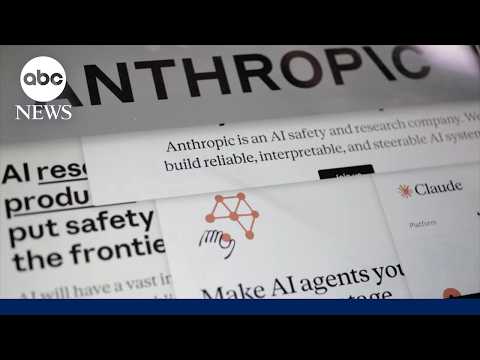
Is AI safe in schools? Anthropic’s ‘Claude for Teachers’ shakes up the classroom
- By
- ABC News
- Length
- 9 min
- Language
- English
- Text from
- the video's captions
- Transcribed
- 14 October 2026
Summary
Anthropic president and co-founder Daniela Amodei speaks with ABC News' Rebecca Jarvis about the launch of Claude for Teachers, a free tool giving K-12 teachers access to Claude Pro for administrative work and tailored curriculum development. Amodei addresses parent concerns, noting Claude remains restricted to users 18 and older because AI's impact on the developing brain is unknown. She also discusses Constitutional AI and Claude's published constitution, model accuracy, energy efficiency, and advice for graduates entering a changing job market.
Key points
- Anthropic launched Claude for Teachers, giving teachers of kindergarten through age 12 free, tailored access to Claude Pro.
- Teachers use the tool for administrative paperwork and for developing curriculum tailored to their state and region's requirements.
- Claude.ai remains restricted to users 18 and older because Anthropic says not enough is known about AI's impact on the developing brain.
- Anthropic uses Constitutional AI to give the models a system of ethics, making them more honest, helpful, and harmless.
- Claude's constitution has been published, and earlier versions drew on documents like the UN's Human Rights declaration.
- Amodei says models are not foolproof, and teachers are trained to spot when AI might be entering unknown territory.
- With every generation of model, Anthropic has become dramatically more efficient at using chips.
- Amodei advises graduates to focus on communication, empathy, and flexibility, saying models predominantly supplement rather than replace human labor.
Questions it answers
00:00Claude for Teachers launch
What is Claude for Teachers and who is it for?
It is a new Anthropic tool giving teachers of kindergarten through age 12 free, tailored access to Claude Pro, designed with input from educators to help with administrative work and lesson planning.
- Free access to Claude Pro for K-12 teachers.
- Built with input from educators.
00:41Classroom uses
How do teachers actually use the tool?
Teachers use it for administrative paperwork and forms, and to develop curriculum tailored to their state and region's specific requirements and their classroom's needs.
- Handles back-end paperwork and forms.
- Tailors curriculum to state and regional requirements.
02:11Parent concerns
What does Anthropic say to parents worried about AI repeating social media's mistakes?
Amodei says Claude.ai remains for users 18 and above, and students under 18 won't have direct access because not enough is known about AI's impact on the developing brain.
- No direct student access under age 18.
- Anthropic cites unknown effects on developing brains.
03:05Accountability for errors
Who is accountable if Claude gives wrong information or reinforces bias?
Amodei says models are not foolproof, and Anthropic has worked with teachers to spot when AI enters unknown territory. Constitutional AI makes models more honest, helpful, and harmless, and harmful response rates have dramatically declined.
- Teachers are trained to spot AI mistakes.
- Constitutional AI aims to reduce harmful responses.
04:36Claude's ethics
Who sets Claude's ethical principles?
Anthropic has published Claude's constitution, with earlier versions drawing on founding documents like the UN's Human Rights declaration, incorporating centuries of human thinking on fair and responsible behavior into model training.
- Claude's constitution is publicly published.
- Earlier versions drew on the UN's Human Rights declaration.
06:56Energy and efficiency
Will AI's energy consumption decrease over time?
Amodei gives no specific timeline but says each model generation uses chips dramatically more efficiently, and Anthropic has long favored doing more with less.
- No timeline given for solving energy use.
- Efficiency improves with each model generation.
07:26Advice for graduates
What should college graduates do as AI changes entry-level hiring?
Amodei recommends focusing on communication, empathy, and flexibility, saying research shows models predominantly supplement rather than replace human labor, and young people native to AI may even have an edge.
- Models supplement rather than replace human labor.
- Human-to-human skills will be ascendant in the workplace.
Notes
Product Launch
- Anthropic announced Claude for Teachers, giving teachers of kids from kindergarten through age 12 free, tailored access to Claude Pro.
- It was designed with input from educators to help with administrative work and tailoring lesson plans.
- Amodei, whose son is entering kindergarten, says she hopes his school adopts the tool.
How Teachers Use It
- Administrative side: filling out paperwork, forms, and back-end classroom work.
- Curriculum side: tailoring lessons to the specific requirements of a teacher's state and region.
Safety and Age Restrictions
- Claude.ai remains for users 18 and above only; students under 18 have no direct access.
- Amodei says this is not because AI is necessarily bad for kids, but because not enough is known about AI's impact on the developing brain.
Mistakes and Accountability
- Amodei acknowledges models are not foolproof and can hallucinate.
- Teachers are trained to spot signs of the AI entering unknown territory and to partner effectively with the tool.
- The tools are not designed to replace thinking; teachers retain deep knowledge of curriculum and students.
Ethics and Constitutional AI
- Constitutional AI is used to align models with human values, making them more honest, helpful, and harmless.
- Claude's constitution has been published; earlier versions relied heavily on founding documents including the UN's Human Rights declaration.
- The rate of harmful responses has dramatically declined over years, per Amodei.
Energy and Efficiency
- No specific timeline for AI solving energy consumption, but each model generation uses chips dramatically more efficiently.
- Anthropic has long been a proponent of doing more with less.
Advice for Graduates
- Anthropic looks for communication, empathy, flexibility, and relating to others.
- Research shows models predominantly supplement human labor rather than replace humans, changing how work is done.
- Younger people who grew up natively with AI may have an edge due to adaptability and human-to-human skills.
Text from the video's own captions. Summary and notes written by AI from the transcript, so check anything important against the recording.
Recently transcribed
- Marc Andreessen: How Movies Explain America
a16z · YouTube · 1 h 16 min
- Marc Andreessen and Ben Horowitz on the State of AI
a16z · YouTube · 39 min
- Joe Rogan Experience #2404 - Elon Musk
The Joe Rogan Experience · YouTube · 3 h 18 min
- Elon Musk - I Cut Off The Money And They Flipped - Joe Rogan
Podcast TV · YouTube · 5 min