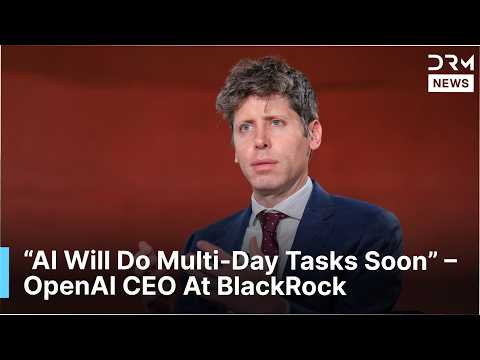
“Flood The World With Intelligence” – Sam Altman On AI | DRM News | AI1F
- By
- DRM News
- Length
- 22 min
- Language
- English
- Text from
- the video's captions
- Transcribed
- 12 October 2026
Summary
Sam Altman, CEO of OpenAI, sits down at an infrastructure conference to discuss the current state of AI, arguing that models have recently crossed into major economic utility. He covers AGI timelines, OpenAI's $110 billion funding round, the Stargate data center buildout, power and efficiency challenges, OpenAI's inference chip, and a new partnership with the North American Building Trades Unions. His core message is a belief in abundance: making intelligence too cheap to meter and flooding the world with it.
Key points
- Sam Altman says AI crossed into major economic utility in recent months, most visibly in coding and science.
- He suggests more of the world's cognitive capacity could sit inside data centers than outside them by late 2028, with huge error bars.
- Startups now plan around how much compute they can reserve rather than how many employees they hire.
- OpenAI raised a $110 billion round with Amazon, Nvidia, and SoftBank as strategic partners.
- Altman frames OpenAI's guiding principle as making intelligence 'too cheap to meter' and flooding the world with it.
- Cost to get the same answer from 01 to 5.4 dropped about 1,000x, showing how early and inefficient the paradigm still is.
- OpenAI is building an inference-only chip focused on being cheapest and most efficient per watt, with first chips deployed at scale by end of year.
- A new partnership with the North American Building Trades Unions will expand training pathways for skilled construction workers.
Questions it answers
00:55State of AI today
Where does Sam Altman think we are in AI right now?
He says models crossed into major economic utility in recent months, most visibly in coding and science, with AI agents moving from multi-hour to multi-day and multi-week tasks.
- AI agents are shifting knowledge workers into supervisory roles.
- Startups now plan around compute capacity, not headcount.
04:07AGI thresholds
How close are we to AGI?
He says AGI has ceased to have much meaning, but offers two thresholds: more cognitive capacity inside data centers than outside, possibly by late 2028, and leaders unable to do their jobs without heavy AI reliance.
- Late 2028 estimate comes with huge error bars.
- CEO roles will become supervising AI systems.
07:26The $110 billion round
Why did OpenAI raise $110 billion?
A $110 billion round, about four times the largest public offering ever, with Amazon, Nvidia, and SoftBank as strategic partners, driven by the enormous cost of committing to infrastructure far in advance of revenue.
- OpenAI spends heavily on infrastructure ahead of revenue.
- The guiding principle is making intelligence too cheap to meter.
12:06Stargate progress
How is Stargate going?
He describes gigawatt campuses like Abilene with about 10,000 workers, where a single researcher command spins up huge numbers of GPUs; challenges include weather events and supply chain issues.
- Abilene is training what he hopes is the best model in the world.
- Many organizations collaborated under pressure as one team.
14:15Power and efficiency
Can power demand be solved?
He is optimistic long-term given gas, solar, fission and fusion, but hopes for per-watt efficiency gains; cost for the same answer dropped about 1,000x from 01 to 5.4.
- Efficiency gains came from kernels, data center design, and models.
- We are still early in the paradigm.
16:51OpenAI's inference chip
Why is OpenAI building its own chip?
It is an inference-only chip designed to be the cheapest and most efficient per watt for agent demand, with first chips deployed at scale by end of year.
- Training and inference are currently distinct phases.
- The bet is opinionated and limited in scope.
19:20Skilled trades partnership
What did OpenAI announce with the building trades unions?
A new partnership with the North American Building Trades Unions expands training pathways for skilled construction workers, whom Altman calls the key bottleneck and foundation for the next generation of American infrastructure.
- Every supply chain choke point needs more skilled tradespeople.
- Sean McGarvey appears later on stage.
Notes
Where AI stands today
- Sam Altman believes AI crossed a threshold into major economic utility in the last few months, most noticeably in coding but also science and knowledge work.
- AI software engineers can currently handle multi-hour tasks, soon multi-day, then multi-week, before shifting to always-on systems with full context.
AGI and thresholds
- Altman says the term AGI has lost meaning; two more interesting thresholds are: (1) more cognitive capacity inside data centers than outside, possibly by late 2028, and (2) leaders (CEOs, presidents, Nobel scientists) unable to do their jobs without heavy AI reliance.
The $110 billion round
- OpenAI announced a $110 billion funding round, roughly four times the largest public offering ever (Aramco's ~$25 billion), with Amazon, Nvidia, and SoftBank as strategic partners.
- Infrastructure is the hardest part of the business: extremely expensive, needed in huge quantities, and committed far in advance of revenue.
Intelligence as a utility
- Altman's guiding principle is abundance: make intelligence 'too cheap to meter,' like electricity or water, so future generations expect geniuses on tap everywhere.
- The business is fundamentally selling tokens; without enough supply, prices spike or society makes bad central planning decisions about compute allocation.
Stargate and power
- Stargate's first site in Abilene is training what Altman hopes will be the best model in the world; gigawatt campuses employ ~10,000 people across skilled trades.
- He is optimistic long-term on power (gas, solar, fission, fusion) but hopes for a per-watt efficiency miracle; cost per answer dropped ~1,000x from 01 to 5.4.
Chips and labor
- OpenAI's own chip is inference-only, an opinionated bet on being the cheapest, most watt-efficient chip for future agent demand, with first chips deployed at scale by end of year.
- A new partnership with the North American Building Trades Unions (with Sean McGarvey) expands training pathways for skilled trades, which Altman calls the foundation for the next generation of American infrastructure.
Text from the video's own captions. Summary and notes written by AI from the transcript, so check anything important against the recording.
More from DRM News
Recently transcribed
- OpenAI CEO Sam Altman warns UN Security Council on AI risks
C-SPAN · YouTube · 9 min