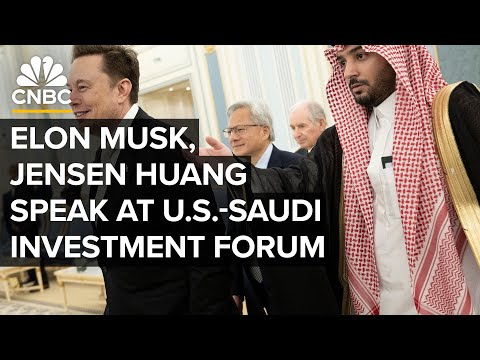
Tesla's Elon Musk and Nvidia's Jensen Huang talk AI at U.S.-Saudi Investment Forum — 11/19/25
- Length
- 30 min
- Language
- English
- Text from
- the video's captions
- Transcribed
- 13 October 2026
Summary
At the U.S.-Saudi Investment Forum, Tesla CEO Elon Musk and Nvidia CEO Jensen Huang discuss AI, robotics, and the new U.S.-Saudi strategic AI partnership. Musk predicts humanoid robots will be the biggest product ever, that work will become optional, and that solar-powered AI satellites in space will be the cheapest way to do AI compute within five years. Huang argues AI is infrastructure, cites radiology as evidence AI increases jobs, and dismisses AI bubble fears by pointing to the massive shift from general-purpose to accelerated computing. Announcements include a 500-megawatt xAI data center in Saudi Arabia with Humain and Nvidia, plus AWS and Omniverse partnerships.
Key points
- Musk says his work is creation, not disruption, and predicts Tesla will make the first useful humanoid robot, the biggest product ever.
- Musk claims AI and robotics are the only way to eliminate poverty and make everyone wealthy.
- Huang explains computing moved from retrieval-based to generative, which is why AI factories are needed worldwide as infrastructure.
- Musk predicts work will become optional in 10-20 years and recommends Iain Banks' Culture novels as a model positive AI future.
- Huang cites radiology, where AI increased productivity and led to more radiologists being hired, as evidence against job-loss fears.
- xAI and Saudi Arabia's Humain announced a 500-megawatt data center with Nvidia, starting with 50 megawatts in phase one.
- Musk estimates solar-powered AI satellites will be the lowest-cost AI compute within five years, since terawatt-scale compute is impossible on Earth.
- Huang rejects AI bubble fears, noting CPUs dropped from 90% to under 15% of top supercomputers in six years and massive non-AI data processing still needs GPUs.
Questions it answers
00:00Opening and first-principles thinking
How does Elon Musk approach disrupting industries like rockets, EVs, and robotics?
Musk says it is mostly creation, not disruption: there were no reusable rockets or electric cars when he started, and there are no useful humanoid robots yet. He believes Tesla will make the first genuinely useful humanoid robot, which he calls the biggest product ever, and that AI plus robotics is the only real way to eliminate poverty.
- Musk frames his work as creation rather than disruption.
- He predicts humanoid robots will be the biggest product ever.
- He claims AI and robotics are the only way to make everyone wealthy.
04:47AI factories and generative computing
Why does Jensen Huang say the world needs AI factories?
Huang explains that computing used to be retrieval-based, retrieving pre-built content, but now software is generated in real time based on context and prompts. Because every generation is unique, AI factories are needed all over the world, making AI part of infrastructure like energy refineries.
- Huang calls AI foundational infrastructure.
- Generative computing replaces retrieval-based computing.
- AI factories are needed worldwide to generate content in real time.
07:57The future of jobs
Will AI take away jobs?
Musk predicts work will become optional in 10-20 years, like a hobby, and recommends reading Iain Banks' Culture books for a positive AI future. Huang says everyone's jobs will be different but cites radiology, where AI made radiologists more productive and more were hired, and argues people with many ideas will actually be busier.
- Musk recommends Iain Banks' Culture novels for a positive AI future.
- Huang says people with many ideas will be busier, not less busy.
- Radiology hiring increased after AI adoption.
13:24Saudi AI success stories and announcements
What AI projects and partnerships were announced?
Musk announces xAI and Saudi Arabia's Humain are building a 500-megawatt data center with Nvidia, starting with a 50-megawatt phase one. Huang adds Nvidia's work with Humain on AWS (100 megawatts with gigawatt ambition), Omniverse digital twins for factories and robotics, and supercomputers to simulate quantum computers. The moderator also highlights Saudi researchers using AI for metal-organic frameworks that capture water and CO2, and nano robots for gene editing against sickle cell disease.
- xAI and Humain are building a 500 MW data center with Nvidia.
- AWS is starting at 100 MW with a gigawatt ambition.
- Nvidia is working on Omniverse digital twins and quantum simulation in Saudi Arabia.
19:06AI in space
Is AI in space possible and why does it matter?
Musk says AI in space is inevitable and argues that to reach even a fraction of a Kardashev 2 civilization, you need solar-powered AI satellites in deep space. He estimates that within five years the lowest-cost AI compute will be in space, since Earth cannot support terawatt-scale compute, while space offers continuous solar, no batteries, cheaper panels, and radiative cooling.
- Musk estimates solar AI satellites beat ground compute within five years.
- Earth cannot support terawatt-scale AI compute.
- Space offers continuous solar and radiative cooling.
24:01Is there an AI bubble?
Does Jensen Huang think we're in an AI bubble?
Huang points to three trends: the end of Moore's law driving a shift to accelerated computing (CPUs went from 90% to under 15% of top supercomputers in six years), hundreds of billions of dollars of data processing moving to GPUs, and recommender systems going generative. He concludes the underlying computing shift justifies the investment, so what remains to fuel agentic AI is less than people think and all justified.
- CPUs dropped from 90% to under 15% of top supercomputers in six years.
- Hundreds of billions of dollars of data processing still need GPUs.
- Recommender systems moving to GPUs justify much of the buildout.
Notes
Context
- Panel at the U.S.-Saudi Investment Forum with Elon Musk (Tesla, SpaceX, xAI) and Jensen Huang (Nvidia), celebrating the U.S.-Saudi AI strategic partnership signed the day before.
- The moderator frames the alliance as shifting from an energy-based economy to the intelligence age, building AI factories, robotics, and EVs.
Musk on creation and robotics
- Musk describes his approach as creation rather than disruption: no reusable rockets existed before SpaceX, no electric cars before Tesla, and no useful humanoid robots exist yet.
- He predicts Tesla will make the first useful humanoid robot, calling it the biggest product ever — bigger than cell phones — because everyone will want one or more.
- He argues AI and robotics are the only way to actually eliminate poverty and make everyone wealthy.
Huang on AI factories
- Huang calls AI infrastructure: it is foundational and will be used by every company, industry, and country.
- Computing shifted from retrieval-based (fetching pre-built content) to generative (unique content per prompt), which is why AI factories are needed worldwide.
Jobs
- Musk predicts work becomes optional in 10-20 years; recommends Iain Banks' Culture novels; expects currency to eventually become irrelevant, with power and mass remaining as constraints.
- Huang: everyone's jobs will change, but productivity frees people to pursue more ideas; radiology saw more hiring after AI because radiologists could study more images and see more patients.
Announcements
- xAI and Saudi Arabia's Humain are building a 500-megawatt data center with Nvidia, starting with 50 megawatts in phase one.
- Nvidia and Humain: AWS starting at 100 megawatts with a gigawatt ambition; Omniverse digital twins for factories, warehouses, and robotics; supercomputers to simulate quantum computers and do quantum error correction.
- Saudi examples: Professor Omaragi (Nobel laureate) using AI for metal-organic frameworks capturing water and CO2; nano robots (500 x 1000 nanometers) for CRISPR gene editing against sickle cell disease.
AI in space
- Musk: AI in space is inevitable; a Kardashev 2 civilization requires solar-powered AI satellites. Earth receives only about one two-billionth of the sun's energy.
- He estimates within five years solar-powered AI satellites will be the lowest-cost AI compute: continuous solar, no batteries, cheaper panels (no glass or framing), radiative cooling.
- Scaling to 300 gigawatts would be about two-thirds of U.S. average electricity usage (~460 gigawatts); a terawatt per year is impossible on Earth.
AI bubble question
- Huang cites three trends: end of Moore's law (CPUs fell from 90% to under 15% of top-500 supercomputers in six years), hundreds of billions of dollars in data processing moving to GPUs, and recommender systems going generative. He concludes the investment is justified and what remains for agentic AI is less than assumed.
Text from the video's own captions. Summary and notes written by AI from the transcript, so check anything important against the recording.
More from CNBC Television
- Sam Altman: People are right to be anxious about AI
YouTube · 6 min