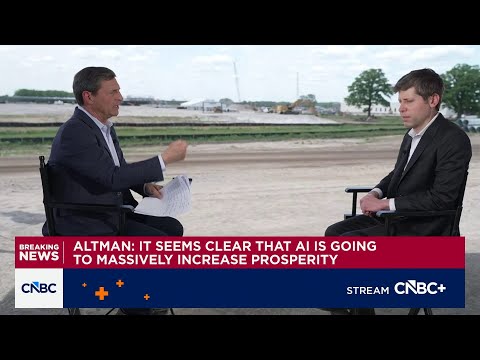
Sam Altman: People are right to be anxious about AI
- Length
- 6 min
- Language
- English
- Text from
- the video's captions
- Transcribed
- 13 October 2026
Summary
In this short CNBC interview, Sam Altman discusses public anxiety about AI, saying people are right to be cautious because it is one of the biggest technological shifts. He clarifies OpenAI's claim about outperforming professionals in 44 occupations, argues the industry has failed to explain how people stay in control rather than failing to sell benefits, and defends iterative deployment. He closes by saying the race with China is okay in some ways but dangerous in others, pointing to global safety risks.
Key points
- Sam Altman says people are right to be anxious about AI, calling it one of the biggest technological shifts, not just a once-a-generation one.
- He wishes OpenAI had said its model outperforms professionals at small tasks in 44 occupations, which he considers more accurate than the original claim.
- He argues the industry has failed not at articulating benefits like curing disease, but at explaining how people stay in control and keep meaningful roles in the future.
- He defends iterative deployment as giving society a chance to see, debate and react to the technology.
- He compares AI model releases to iPhone releases, saying people now expect models to keep getting better and instead want to know what happens with society.
- On the race with China, he says going full speed is okay in some ways but really dangerous in others, pointing to global safety issues.
- He cites the IAEA for atomic energy as an example of the world coming together to avoid global risks.
- He says OpenAI's whole effort is about democratizing power, wealth, opportunity and agency at massive scale.
Questions it answers
00:00The 44 occupations claim
What did Sam Altman wish OpenAI had said about its model outperforming professionals?
He wishes they had said it outperforms professionals at small tasks in 44 occupations, which he considers more accurate, and he says people using these tools are seeing productivity and wage growth.
- The original claim was about small tasks, not whole jobs.
- Altman says people are right to be anxious about AI.
01:13The backlash and iterative deployment
How does Altman respond to concerns about the AI backlash?
He says it's a huge challenge and that society should have antibodies against too-rapid change; OpenAI's iterative deployment strategy is meant to let society see, debate and react to the technology.
- Iterative deployment lets society debate and react.
- He wants AI to work for people, with human values driving it forward.
02:25What people really want to know
Why does Altman think the industry's messaging has failed?
He says the industry has failed to explain how people stay in control and keep meaningful lives, not the upsides; messages about destroying most jobs while becoming the most valuable company are terrible.
- People believe benefits like curing cancer.
- The real question is people's role, economic future and agency.
03:33Pace of change
What does Altman think about the pace of model releases?
He compares it to iPhone releases, saying people now expect models to keep getting better and instead want to know what happens with society.
- Model releases are becoming routine like iPhone releases.
- The societal question matters more than model improvements.
04:28The race with China
How does Altman view the race with China?
He says it's okay in some ways and really dangerous in others, citing global-scale safety issues and the IAEA as a precedent for the world coming together on big risks.
- Full-speed competition has dangers.
- Global coordination is needed on the biggest risks.
Notes
Overview
This short CNBC interview with Sam Altman covers public anxiety about AI, the AI backlash, and the pace of development.
Anxiety about AI
- Altman says people are right to be anxious because this is "one of the big ones" — not even a technological shift that happens every generation.
- He believes society should have "antibodies" against too-rapid change.
The 44 occupations claim
- Asked about the claim that a model (5.2) outperforms professionals across 44 occupations, Altman says he wishes they had said it outperforms professionals at small tasks in 44 occupations, which he calls more accurate.
- He notes people actually using these tools are seeing productivity growth and wage growth.
The backlash and messaging
- Altman rejects the idea that the industry simply hasn't articulated the benefits; people believe claims like curing disease.
- He says the industry has failed to articulate how people stay in control of determining the future and keep meaningful lives.
- He calls messages like "AI will destroy most jobs, we'll give you basic income" a terrible message.
Iterative deployment
- OpenAI's strategy of iterative deployment is meant to let society see the technology, understand it, debate it, and react.
- He has no interest in building super-smart AI pursuing non-human goals; human values must drive it forward.
Pace of change
- Comparing to iPhone releases, he says people now expect models to keep getting smarter; what they really want to know is what happens with society.
Race with China
- Altman says going full speed ahead is okay in some ways and really dangerous in others.
- He points to global-scale safety issues and cites the IAEA for atomic energy as a precedent for the world coming together on big risks.
Text from the video's own captions. Summary and notes written by AI from the transcript, so check anything important against the recording.