Full transcript
Psychology of serial killers | Julia Shaw and Lex Fridman
00:02Speaking of which, you've done a lot of really great podcast shows. One of them is Bad People Podcast. You co-host it. It has over 100 episodes, each covering a crime. What's maybe the most disturbing crime you've covered? One of the most disturbing crimes that we covered on Bad People, and just to be clear, Bad People, much like the title Evil, is tongue in cheek, where the idea is it's people whom we refer to as bad people. And then it's always a question of who are these, quote unquote, "bad people," and are we all capable of doing these terrible things? But one of the most, certainly, problematic, dark cases that we covered was the Robert Pickton case. And the episodes are called Piggy's Palace, because that was the
00:47nickname for the farm where Robert Pickton brought victims whom he had kidnapped, and then he killed them, and he did terrible things to their bodies. And rumors have it, certainly, that he fed some of these victims to pigs. Now, one of the reasons I covered that case is actually because it was influential in my own career. So, Robert Pickton is one of the most famous Canadian serial killers of all time. And as I was doing my undergrad at Simon Fraser University in Canada, I was being taught by someone called Stephen Hart. And Stephen Hart was an expert witness on the Robert Pickton trial, and so he was keeping us abreast of some of the developments of what he was covering. And I found it so interesting,
01:30and I loved Stephen Hart as a person, and he seemed to have this sense of humor, this gallows humor, around it all, despite being faced with one of the arguably worst people in Canadian history. And I thought that that was so interesting, that someone could be so nice, so kind, so wonderful, and be an expert witness for these kinds of people. And so that's one of the reasons I went into the field is because of this case as well. And so we had him on the show. So he came onto Bad People and we interviewed him for it. - All right. And he has done, I imagine, a lot of really difficult cases. - Yes, he's done a lot of difficult cases, as have other researchers like Elizabeth Loftus, who's one of the
02:09main founders of the area of false memory research, which is what I also do. I do research on memory and false memory and witness statements. And Elizabeth Loftus has also been a recent expert for the Ghislaine Maxwell case. She was in the press. She was in the press, and so she has worked with lawyers to educate the court on memory in lots of really, really controversial cases. But the way she would explain it is that it's still her role to just train people and teach people on how memory works. She's not there to decide whether people are guilty or innocent, but she is there to help people distinguish between fact and fiction when it comes to how our memories work or don't. - So what kind of person feeds their victims to pigs? What's
02:53interesting about that psychology? - The psychology about Robert Pickton? I mean, he was a tricky person because I think he was profoundly lonely, and this is something we see with a lot of serial killers is that they have this loneliness, which I think not only contributes to them committing the crimes in the first place, but also allows them to get away with things because they don't have as much of a social network or any social network that is helping them to do what's called reality monitoring, to understand what's true and what's not. And so when you see people get radicalized in their own thoughts, whether that's in the sense of things like schizophrenia where you've got psychosis, you've got delusions, maybe command hallucinations. That's
03:33when you think you're hearing voices and someone is telling you that you have to do something, usually something harmful to other people. And if you don't follow those, you will hear those voices forever. They're profoundly distressing, and they are one of the aspects of schizophrenia that if you have, it does make you more prone to violence. And so for these kinds of cases, if you don't have someone intervening, whether that's a family member or a therapist saying, "How can you tell whether this thought is real?" Maybe that thought, maybe you're not hearing that voice, right? Maybe that aspect of what you're thinking isn't true and bringing you back closer to reality. You can just wander off
04:11to whatever alternate universe that you might live in in your head, and it's the same with radicalization in other contexts is that you see that people who drift more and more into a certain group that has certain beliefs that are maybe divorced from the evidence, divorced from reality. You can see that people will get more extreme over time, and unless you have a tether that brings you back, that allows you to do reality monitoring, it's going to be very difficult to find your way out of that. So with serial killers, we find this reality monitoring problem, and I think part of that's related to the lack of social networks that people have. - That's fascinating. So that's one important component of serial killers. What else
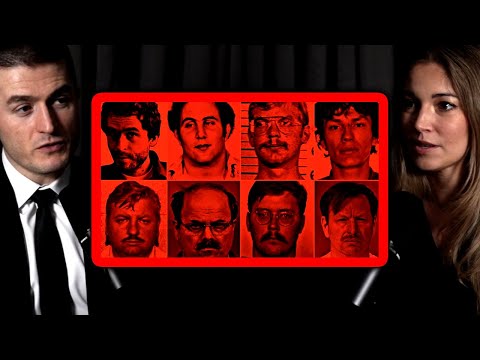
04:50can we say about the psychology? What motivates them? So if you look at some of the famous serial killers, Ted Bundy, John Wayne Gacy, Jeffrey Dahmer, is there other things we could say about their psychology that motivates them? So interesting, the tether to reality. I mean, loneliness is a part of the human condition. It is, in fact, one of its side effects is you can get untethered. And then with some of these brains, I guess the untethered goes to some dark place. - The untethered goes to a dark place, and it then is often combined with some of these other dark tetrad traits. So you've got someone who maybe is high on psychopathy, low on empathy, someone who's high on sadism, someone who thinks
05:35that it's okay to pursue your own goals. And your own goal can be, like with Jeffrey Dahmer, you can be wanting to create the perfect partner, which in some ways seems to be what he was trying to do by killing people and piecing them together and sewing up a sort of new version. There's something in that where I can't help but go, "That's so sad." I don't go, "Oh my God, how awful." Of course it's atrocious. Of course it's heinous, but I have this real sympathy for that, and I think that's important for us to have, though. And not to say, "I can't relate to this person at all," but to say, "That is an extreme manifestation of something I have felt, and the difference between me engaging in that and this person engaging in that are these other
06:21factors." But the core is in all of us. - Do you think all of us are capable of evil, of some of the things we label as evil? - I think all of us are capable of doing basically the worst things we can imagine. And one of the reasons I think that is because you can see neighbors turning on each other, especially if you look historically at the start of wars or big political moments where you have people who would have called each other friends turning each other in to the police, killing each other, doing terrible things. So I think all it takes is to become convinced that the people you think are your friends are actually your enemies, whether that's just in your own world or in a larger political national landscape that
07:04I don't think it takes all that much for us to be capable of doing terrible things. But that's also why it's really important when things are good and when you're not at war and when you have the capacity to think deeply about important issues, to train your mind on these thoughts of knowing that things like loneliness can manifest in these extreme ways, that things like jealousy and aggression, that they can turn into murder, that they can turn into these horrible versions. And to then also spot the red flags if you start going down that path. I think if we don't rehearse evil, if you will, we are much more likely to engage in it, especially in those moments where we don't have much time or energy to really think about what
07:46we're doing. - Yeah, I really appreciate the way you think and the way you talk about this. Listening to history, when I'm reading history books, I imagine myself doing the thing I'm reading about, and I almost always can imagine that, like when I'm being honest with myself. - And it's important to admit that to ourselves. And research on murder fantasies finds that most men have fantasized about killing someone, about 70% in two studies. And most women as well. More than 50% of women have fantasized about killing somebody. So murder fantasies are incredibly common, and certainly according to some researchers, that's a good thing. Being able to rehearse and think through doing the most terrible
08:32things is a great dress rehearsal for also how we don't want to live our lives. And only if you are able to fully think through, "What would I actually be like if I was engaging in this? What would I be thinking? Who would I be with? What would be my... the group that I'm charging against this other person? You know, who am I there with?" As you said, like really putting yourself in the shoes of these people who have done terrible things. That is how you also realize that you do not want those consequences. And so yeah, you maybe want to murder this person, but you don't really want to murder this person. That's that intuitive sort of animalistic brain coming in. But then luckily, we have higher reasoning that goes, actually, if you think this through, that's a pretty
09:16terrible consequence for yourself. So the better thing to do is not to murder this person. So I think it's adaptive to be able to fantasize and think about these things. Obviously, if you start getting to a point where you're ruminating and you're going in these circles where you're constantly fantasizing about doing dark things, especially to a specific person, I'd always advise seeing somebody, to talk to a psychologist, for example. Because that then does become a risk factor for acting on those dark fantasies. But up to that point, if it's just a fleeting thought or something that in one day you had these thoughts, that is totally healthy, I would say. - And also, I think it's useful to simulate or think through what it would take
09:57to say no in that situation. Meaning, once you're able to imagine yourself doing evil things, you have to imagine the difficult act of resisting. A lot of people think they would resist in Nazi Germany. Well, most people didn't, and there's a reason for that. It's not easy. Same reason, I've seen this. If something bad is happening on a public street, most people, it's the bystander effect. Most people just stand there and watch. I've seen it once in my life. Yeah, this is humans, so it's actually you want to simulate stepping up. - Yeah, so it's also been called the heroic imagination. Someone who has studied evil, quote unquote, at length is Philip Zimbardo. He did the Stanford Prison Experiment, and that was an experiment which is... I mean, it's now been
10:49torn apart in various ways. It was absolutely influential for psychology. It's where participants were randomly assigned whether they would be prisoners or guards in a mock prison experiment, and then for a number of days, they were told to do various things. And it got out of control, and the guards went way over what they were supposed to be doing, and they effectively started pseudo-torturing some of these inmates or these pretend inmates. And the whole thing had to be stopped prematurely, but it was really fundamental in showing how just by randomly being assigned into guard, the person in charge, or inmate, you can, within a matter of days, have a completely different way of thinking about one another. And
11:31so Philip Zimbardo has also spoken at length about evil and that all of us are capable of it in the right circumstances, but he also is a big proponent of what he calls the heroic imagination. And the heroic imagination is really what the purpose of everything I do is. The purpose of what I do isn't just to go, "Ooh, this is curious," and to stop there. The point is to then prevent it, and to prevent it in ourselves because that's, I think, ultimately what has to happen. You can't do a top-down sort of government-level approach to trying to be so tough on crime that no one will ever commit crime. That's impossible. But you can change, to say it in a tacky way, the hearts and minds of individuals to recognize the
12:10pathways towards evil and to go, "Wait, I'm off track. I don't want to go this way, and I'm going to stop myself here, and here's how I can find my way back." And so the heroic imagination is exercising that. I see someone on the street. How do I make sure that they're okay? How do I not become a bystander? And actually, the bystander stuff is interesting because there was a really famous case, the murder of Kitty Genovese, and there were all of these both ear and eyewitnesses. So an ear witness is someone who just hears things, and an eyewitness is someone who sees the crime happening, and they didn't intervene in the murder of this woman. And so this case was often taken as this almost example of, "Look how terrible human beings are. We just walk by. We
12:53don't care about what's happening to strangers on the streets." And actually, what's happened since is that there's been lots of other bystander experiments, and they have not substantiated this. So we need to be very careful with looking at these extreme cases and going, "How horrible that this happened to this one person," and it is. But that doesn't mean that that's always how it happens. And so actually, what we find in bystander research is that most of the time, bystanders do intervene. It's just when there has already been a crowd that has accumulated, you read the room, and you assume, "Well, nobody else has intervened yet, and so it must not be a real problem." That desire to not stand out in a negative way is often what hinders heroism.
13:35I mean, that's why we look at heroes, people who especially risk their own lives to save others, especially strangers. We see them with a sort of respect that nobody else gets, and that's because we recognize that we might not be capable of that. and that's because we recognize that we might not be capable of that. If I saw a stranger drowning in a river, would I really risk my life jumping in the river to maybe save them? I think that's a big question mark. And so when people do that, especially when people almost have this inherent reaction that they just jump in, they just go for it, that is something that is a really admirable quality that we as humans do celebrate, and we should. And I think often we should celebrate those incidents more and not
14:18the, you know, the bystander moments where we didn't intervene. We should be normalizing intervening. - And again, this idea of heroic imagination, actually simulating, imagining yourself standing up and saving the person when a crowd is watching, they're drowning, to be the one that dives in, tries to help. You mentioned