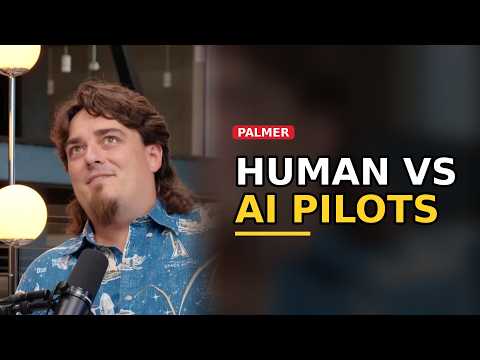
Human vs. AI Pilots: Palmer Luckey Weighs In #shorts
- Length
- 5 min
- Language
- English
- Text from
- the video's captions
- Transcribed
- 13 October 2026
Summary
Palmer Luckey discusses how human pilots and autonomous systems differ, arguing that human pilots work within industry constraints that discourage aggressive evasive action, while robots act maximally safe. He describes how simulation demonstrations, like collision avoidance in GPS jamming scenarios, convinced skeptics of autonomous safety systems. He also stresses that exercises must be realistic, overloaded, and full of unexpected worst-case scenarios, and that early testing is essential because late fixes can be non-viable.
Key points
- Human pilots work within industry constraints and avoid aggressive evasive maneuvers to keep passengers comfortable and keep their jobs, while a robot would take maximum evasive action at the first sign of trouble.
- Simulations showing collision avoidance, such as the recent GPS jamming scenario that took out medevac pilots, convinced people that autonomous safety systems can save every person in the sim.
- Many exercises are too scripted and easy, and should instead include unexpected scenarios like enemy fire, offline support systems, degraded stability augmentation, or aircraft overdue for maintenance.
- Luckey's systems often fail in worst-case scenarios because his team are 'computer kids', and systems that work in a science fair project can fall apart in real conditions.
- Testing early in the design phase is essential, because fixes discovered too late may be totally non-viable, such as replacing an unworkable tablet UI after 5 years of development.
- Luckey dislikes touchscreens and values tactile feedback, joking that Steve Jobs 'ruined technology' despite respecting him.
Questions it answers
00:00Human vs. robot pilots
Why do human pilots and autonomous systems behave differently in flight?
Human pilots work within industry constraints, flying smoothly and hiding trouble to avoid bad reviews, while a robot takes maximum evasive action at the first sign of trouble.
- A charter pilot avoids aggressive evasive maneuvers to keep passengers happy and keep the job.
- A robot will do the most evasive action at the first sign of possible trouble.
01:06Seeing is believing
How did demonstrations convince people of autonomous safety systems?
Simulations like the recent GPS jamming scenario that took out medevac pilots show that integrated safety systems can save every person in the sim, which convinces people.
- Many pilots would suffer controlled flight into terrain in the GPS jamming scenario.
- Integrating safety systems meant everyone in the sim lived.
01:38Realistic, overloaded exercises
What's wrong with scripted exercises, and what should testing look like?
Exercises should be realistic, representative of actual workflow and workload, and ideally overloaded, including unexpected scenarios like enemy fire, offline support systems, degraded stability augmentation, and overdue maintenance.
- Luckey flies a Eurocopter EC120 daily and wouldn't want hydraulics out at night in the weather.
- Unexpected, worst-case scenarios should be part of exercises.
- Many of Luckey's systems fail in worst-case scenarios because his team are 'computer kids'.
03:49Early testing
Why test early rather than late in development?
Test early in the design phase so problems can be fixed, because late fixes may be non-viable, like ripping out 5 years of tablet development.
- Voice controls read over the radio vs. a dedicated tablet is an example of a design choice that can fail in high workload.
- Touchscreens are challenging in high workload environments.
04:22Touchscreens and Steve Jobs
What does Luckey think about touchscreens and tactile feedback?
He hates touchscreens, loves tactile feedback, misses his Blackberry, and jokes that Steve Jobs 'ruined technology' despite respecting him.
- Tactile feedback is critical to Luckey.
- He respects Steve Jobs but blames him for touchscreen dominance.
Notes
Human pilots vs. autonomous systems
- Human pilots work within industry constraints, like a chauffeur: everything must be smooth, and trouble shouldn't show until it has to.
- A charter helicopter pilot won't take aggressive evasive action at the first sign of trouble because it leads to bad reviews and job loss; a robot will.
- Fighter pilots love to fly, but more than that, they want to win.
Seeing is believing
- Demonstrating autonomous capability in simulations convinced people, especially collision avoidance.
- Example: recent GPS jamming took out medevac pilots; many pilots put in that situation would have controlled flight into terrain, but integrated safety systems meant every person in the sim lived.
Realistic, overloaded exercises
- Exercises should be realistic, representative of actual workflow and workload, and ideally overloaded.
- Scripted exercises hide reality: unexpected enemy fire, support systems offline, loss of stability augmentation in a rotorcraft, or no maintenance for 3 weeks in wartime.
- Luckey's daily flyer is a Eurocopter EC120; he can fly it hydraulics out, but wouldn't want to in a high-workload situation, at night in the weather, or overseas without his emergency suit.
Early testing
- Systems that work great in the lab or sim often fail at real-world edge cases.
- Luckey admits a lot of his company's stuff totally fails in worst-case scenarios because his guys are 'computer kids'.
- Test early in the design phase; if you wait too long, fixes may be non-viable — e.g., discovering a control tablet is unworkable after 5 years of development.
Touchscreens and tactile feedback
- Touchscreens are challenging in high-workload environments.
- Luckey hates touchscreens, loves tactile feedback, misses his Blackberry, and jokes that Steve Jobs 'ruined technology' despite respecting him.
Text from the video's own captions. Summary and notes written by AI from the transcript, so check anything important against the recording.
More from Du Cavendish
Recently transcribed
- Greg Brockman on what the best engineers and leaders do today
Allie K Miller · YouTube · 23 min
- Sacks, Andreessen & Horowitz: How America Wins the AI Race Against China
a16z · YouTube · 1 h 17 min
- Trump's Tech Czar on Crypto and American Innovation
a16z crypto · YouTube · 1 h 18 min