Full transcript
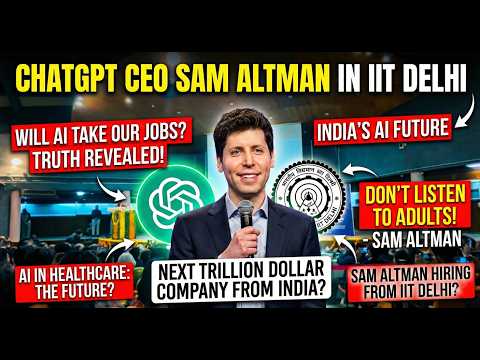
ChatGPT CEO Sam Altman at IIT Delhi | Will AI Take Our Jobs?🔥
Opening remarks
00:03Uh or just a I think to have a lot tight security What you can so take job legal good scope or have the future imagine is the registration Dog or you overflow if register candidates and then I will department especially faculty I tell and then opinion >> [applause]
00:45>> is a two parts first part I think alumni because I was Joe open investors on God I'm open chat session a question so I can director again come here I think I can I can education research >> It was no Mr. Sam we know come here we realize the dog or we are going to be in >> or director come speech come on a man session >> He saw me young people maybe talk about Yeah. This is a wonderful trip. Uh so good for me and a lot more today this is the thing I've been most looking forward to of the entire trip. Uh watching what's happening with young people around the world. Uh especially building with incredible energy what they are. Uh the new startups that are going to happen that are already happening
Advice to students
01:49the new products services going to get created they just totally embrace >> [clears throat] >> and the excitement and the to bring all of this agency and energy and you know, speed to the future is awesome. I have a 1-year-old kid uh and he is never going to know a world where he is smarter than a computer. Ever. He was born just at the right time to be never outrun by a computer in raw intelligence. And you know, for him it'll be totally normal life. And any any technical skill you learn today, you're better at it. Um it's still worth learning. You know, like someone asked me recently, "Do I regret learning to program?" Um because, you know, clearly the AI is a better programmer than you know,
02:37me. And the answer is uh not at all. I also don't regret learning math, even though I never use math as an adult. Uh learning how to think, learning how to learn quickly, this is all valuable skill, but it it was all of the meta skills that matter. >> I think what matters is the technical knowledge they have that an electrical engineer can do a structural engineer's job quite easily. And by the way, you're building both structural engineers, ship designers, uh and um electrical engineers in San Antonio. That means use information everywhere. So, what do you think matters? >> Well, I know I just said this, but I I can't emphasize enough how important I think it is to stay on the forefront of the tools. I expect that to be a company
03:25accelerator. Uh so, building projects all of the time just figure out what what's going to be possible, and it's going to rapidly increase every couple of months from now now on. That that really matters. >> So, I really encourage all of you to go be risk-taking. There's so much opportunity to take advantage of it. Take advantage of your curiosity, uh agency, risk-taking, and then persistence because the path is never simple or or smooth. So, you have to persist through the hard times. Thank you. I think >> for students to ask their own questions. For this, I'd like to invite on stage Mr. Raghav Gupta, the head of education for OpenAI in India. He's currently leading partnerships with academic institutions, ensuring that AI
Q&A on jobs and skills
04:22is integrated into the company. >> [applause] >> Are you all excited for this conversation this afternoon? >> My question is, what do you say to the workers who feel that their jobs will be outdated in the next 5 years? And what skills should they be focusing on? >> [clears throat] >> Anyone who says they're only excited or only fearful about AI is something not being very thoughtful. I don't think it's two camps. I think there's two groups of people based on whether you're 90% excited and 10% fearful or 90% fearful and 10% excited. But, as with any change of this magnitude happening this quickly and with this much unknown, this much promise, this much obvious peril, it's you have to be somewhere on that
05:10spectrum. You can't You can't be sort of at at either end. >> [clears throat] >> Um a big part of that is what the impact on jobs is going to be. And I will caveat this with one of the other things by AI by saying that no one really knows, including us. There will be many surprises. Some jobs will probably go away. Many jobs will not change as much as it seems like they should uh with AI because we have, you know, we want someone else to be doing that. We still want a human doctor to tell us things even if they we know that AI guess better advice or any many other set of examples. Um or, you know, entrepreneurs will still start companies. They'll just grow faster. They'll do more. They'll be more productive to existing jobs. Every
05:59time in history that there's been a major technological shift, we have underestimated how quickly the new jobs were going to come and how different they were going to be. It'd be very hard to think about my job, for example, before computers were invented. Um impossible to [clears throat] think about my job before, say, the Industrial Revolution. Um there are jobs now that are incredibly good jobs that didn't exist as a category 20 years ago, even. But we never run out of things to do. We have never gotten to the sort of like thing that people have theorized for for centuries now, which is technology's going to progress so much that we just sit around and do nothing. We find new things to do. We find new ways to
06:36express our creativity. Um we find new ways to be useful to each other. We find new ways to, you know, gain status, or whatever it is. Many of you will eventually do jobs that don't exist today, even only as a concept. It doesn't mean that the transition is not painful. I expect for many people that it will be very painful. As society gets richer, hopefully, I hope we find new socio-economic models to make it less painful. But I'm less worried about the long-term future. I think people find new things to do in not very long. >> How would you rethink uh health and AI in a country like India? >> I don't have these intentions to improve health. I don't have it connected to anything. I type in lots of notes. Every time I
AI and health in India
07:20get like a blood test or something, I upload it. Every time I have symptoms, I type it in. It works really well without medical records. Um we'd love to connect to any platforms that emerge in India as important platforms, but one of a huge volume of chat GPT is health-related queries, and with no connectors at all, we've worked to make it very clear. Man, I'm going to insist this this talk is not recorded. I >> [laughter] >> I think listening to old people
Career advice and rapid-fire questions
07:59I think your your parents obviously love you more than anyone. They're extremely well-meaning. Um for advice about how to live a happy life or how to be a a good person, there's no one who should listen to them more. More than your parents. Um but for a predictor of what the world's going to be like going forward, um I wouldn't trust me for having good intuition at the rate of change. Young people always figure this out the best. And the world you are all inheriting is going to be very different. And you'll have to quickly develop your own intuitions and trust them. Um but I think traditional career advice is probably not going to work as well. >> So, will the next billion-dollar AI company come from India?
08:46>> I hope so. >> Most overrated fear about AI? >> [clears throat] >> Killer robots in the streets. >> Most underrated opportunity? >> Zero-person companies. >> Bigger change in 5 years, education or health care? >> Education. >> And last, one skill every IIT >> I hope so. >> Last question, one skill every IIT student should build this year. >> Resilience. >> Resilience. Wonderful. >> [applause] >> Thank you. >> Is it about
09:30To those who come AI But you the job comment or blog