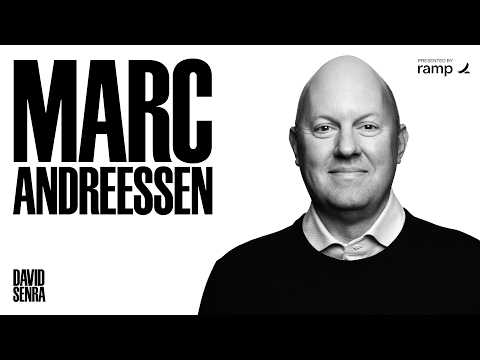
Marc Andreessen: The World Is More Malleable Than You Think
- Length
- 1 h 50 min
- Language
- English
- Text from
- the video's captions
- Transcribed
- 13 October 2026
Summary
Marc Andreessen sits down with David Senra for a wide-ranging conversation covering his views on introspection, why founders rather than managers should run companies, the origins and design of a16z, his early days with Jim Clark at Netscape, the history of moral panics around new technology, and Elon Musk's management method. Andreessen argues the world is more malleable than people think, that incumbent institutions run by managers are collapsing, and that Musk has cracked the code of combining founder creativity with large-scale execution. He also recounts stories from Mosaic, Netscape, Silicon Graphics, and the birth of the commercial internet.
Key points
- Andreessen practices near-zero introspection, arguing that dwelling on the past gets people stuck and that great entrepreneurs historically did not engage in it.
- He credits James Burnham's book 'The Machiavellians' for the distinction between bourgeois capitalism (founder-led, like Henry Ford and Elon Musk) and managerialism, and argues managers can't handle rapid change.
- The core thesis of a16z is that you're more likely to build something important by starting with a founder and training them on management than starting with a manager and training them to create.
- Andreessen and Ben Horowitz studied the 'barbell' or 'death of the middle' pattern in professional services industries, including Michael Ovitz's CAA, to design a scaled venture firm.
- Jim Clark predicted both the fall of Silicon Graphics' workstation business and the rise of networking; Nvidia is essentially based on his ideas, Andreessen says.
- Andreessen was personal tech support for the Mosaic browser and saw 400 commercial licensing requests arrive before founding Netscape with Jim Clark in 1994.
- Every new technology, from bicycles ('bicycle face') to jazz to hip-hop to the internet, has triggered a moral panic, and the press consistently amplifies these panics.
- Elon Musk's method is to go straight to the engineer who is the source of truth, map the production process, and fix the single biggest bottleneck every week, doing roughly 120 five-minute design reviews in a day.
- Andreessen proposes a 'MilliElon' metric for founders and notes Michael Moritz passed on Tesla because he underestimated Musk's determination and pain tolerance.
- Starlink succeeded where Teledesic (Bill Gates, Craig McCaw) and Iridium (Motorola) failed catastrophically, because reusable rockets made launching satellites cheap.
Questions it answers
00:00Caffeine and no introspection
Why does Marc Andreessen avoid introspection?
He believes dwelling on the past gets people stuck, at work and at home, and that great entrepreneurs historically never practiced it. He traces modern introspection to Freud and the 1910s–1920s and says it never resonated with him.
- He cut back on caffeine after noticing his heart skipping every tenth beat.
- Great founders often have 0% neuroticism, though some great entrepreneurs are very neurotic.
- He refuses psychedelics, citing founders who quit their companies after using them.
05:36Technology against stagnation
What is Andreessen trying to do in the world?
He believes technology is an enormously powerful force and that the world's problem is there's not enough of it. Entrepreneurs are a rough movement against stagnation, and without them there's nothing but stagnation.
- Nobody licensed VCs or entrepreneurs to do this — the fields are completely open.
- He's suspicious external impact is his real motivation; his story to himself is competing with himself.
10:42Founders vs. managers
Why does Andreessen believe founders should run companies?
Drawing on James Burnham's 'The Machiavellians,' he contrasts founder-led bourgeois capitalism with managerialism, and argues managers can't adapt when things change quickly. The a16z thesis is to start with the founder and train them on management.
- Mark Zuckerberg, who never had a job before Facebook, is the classic 'double threat' example.
- HP was run by its founders for 50 years and was the original Silicon Valley company.
- SpaceX's reusable rockets show why management skills can't compete with founder adaptation.
21:30Founding a16z
How did Andreessen and Horowitz design their venture firm?
After years as angels arbitrating founder-VC conflicts, they studied the 'barbell' pattern across talent agencies, investment banks, private equity, and retail, and built a scaled platform rather than a tribe of lone wolves.
- Legacy venture firms were melting down from internal strife and generational succession problems.
- Ovitz's CAA showed the power of the firm over the solo agent.
- The Valley's shift from tools businesses to directly competing with incumbents (Airbnb, Uber, Tesla) demanded scaled venture.
46:00Jim Clark and Silicon Graphics
What happened between Jim Clark and Silicon Graphics?
Clark, the volatile founder, fought with the professional CEO over pursuing cheap 3D chips and networking. He left, correctly predicting that $50,000 workstations would become $300 chips — which is what Nvidia became.
- Clark's technology powered 'Jurassic Park' and 'Terminator 2.'
- Nvidia is fundamentally based on Clark's ideas.
- Andreessen was the only one of twelve at an Il Fornaio dinner to join Clark's new company.
58:00Mosaic and Netscape
How did the commercial internet begin?
Andreessen built Mosaic at Illinois under NSF funding, personally handled tech support and commercial licensing emails, and saw 400 commercial requests pile up. With the Acceptable Use Policy revoked, he and Clark founded Netscape in April 1994.
- Netscape invented early internet advertising, e-commerce software, and online publishing.
- It was the largest internet advertising company until Yahoo passed it around 1997.
- Early press coverage insisted nobody would ever put a credit card online.
1:11:00Moral panics
How have people historically reacted to new technology?
Every new technology triggers a moral panic — from written language and bicycles ('bicycle face') to jazz, comic books, rock and roll, hip-hop, and the internet. The press consistently amplifies these panics because fear sells.
- 'Bicycle face' was the claim that women's faces would freeze from exertion and they'd never find a husband.
- The Pessimist Archive documents contemporaneous newspaper panic articles.
- Edison thought the phonograph would be used for sermons; it was immediately used for music.
1:31:00Elon Musk's method
What makes Elon Musk's management approach unique?
Musk goes straight to the engineer who is the source of truth, maps each company's production process, and personally fixes the single biggest bottleneck every week, doing roughly 120 five-minute design reviews in a day. Andreessen calls it possibly the least studied and understood thing in the world right now.
- IBM's 12 management layers and 'Big Gray Cloud' insulated the CEO from all truth.
- SpaceX feels like 'a zone of shocking competence' due to positive selection of engineers.
- Starlink succeeded where Teledesic and Iridium failed catastrophically.
Notes
Introspection and Motivation
- Andreessen says he has "zero" introspection, believing people who dwell on the past get stuck; he notes great historical entrepreneurs like Sam Walton simply kept building.
- He traces modern introspection to Freud and Vienna in the 1910s–1920s, calling it a manufactured construct that never resonated with him.
- He distinguishes extrinsic motivations (impact, money, fame) from intrinsic ones, arguing only intrinsic motivations get successful people up in the morning. His own story to himself: competing with himself to become a better version of himself.
- On psychedelics: he's never used them and never will, citing founders who came out the other side "at peace" but quit their companies. Huberman's response: "How do you know they're not happier?" Andreessen: "Yeah, but their company is failing.
Founders vs. Managers
- James Burnham's "The Machiavellians" describes two modes: bourgeois capitalism (founder runs the company — Henry Ford, Elon Musk) and managerialism (interchangeable managers, business schools, conglomerates).
- Burnham argued large-scale systems need trained managers, but Andreessen says the last 30 years show managers can't handle change — SpaceX's reusable rockets being the classic example.
- Core a16z thesis: start with the founder and train them on management, rather than the reverse. Mark Zuckerberg is cited as the "double threat" who learned to run at scale while staying the innovator.
- HP, run by its founders for 50 years, was the original Silicon Valley company; Intel's founders modeled themselves on it.
Building a16z
- He and Ben Horowitz spent 2003–2009 as active angels, repeatedly pulled into founder-VC conflicts, before deciding to "write the 10 million dollar check" themselves.
- They studied the "barbell" / "death of the middle" across talent agencies (Ovitz's CAA), investment banks (J.P. Morgan, Goldman Sachs vs. Allen & Company), private equity (KKR), and retail (Walmart/Amazon vs. boutiques).
- Ovitz's CAA tactics: 7 a.m. staff meetings, calling clients (and competitors' clients) by 8 a.m., rolling 20 agents deep in matching suits and Jags.
Jim Clark and Netscape
- Clark founded Silicon Graphics, was pushed out after fighting with a professional CEO, and predicted both cheap 3D chips (Nvidia's path) and networking (the internet).
- Andreessen, 22, was the only one of a dozen at an Il Fornaio dinner to say yes to joining him — then wrecked his new car after unknowingly getting drunk on red wine.
- Netscape invented early ad formats, e-commerce software, and put The Wall Street Journal online; it was the largest internet advertising company until Yahoo passed it around 1997.
Elon Musk's Method
- The opposite of IBM's "Big Gray Cloud": Musk goes straight to the engineer who is the source of truth and fixes the bottleneck himself.
- He maps production processes, fixes the single biggest bottleneck weekly, and does roughly 120 five-minute design reviews per day.
- Andreessen proposes the "MilliElon" as a founder metric and notes Starlink succeeded where Teledesic and Iridium failed.
Text from the video's own captions. Summary and notes written by AI from the transcript, so check anything important against the recording.
More from David Senra
Recently transcribed
- Greg Brockman on what the best engineers and leaders do today
Allie K Miller · YouTube · 23 min
- Sacks, Andreessen & Horowitz: How America Wins the AI Race Against China
a16z · YouTube · 1 h 17 min
- Trump's Tech Czar on Crypto and American Innovation
a16z crypto · YouTube · 1 h 18 min