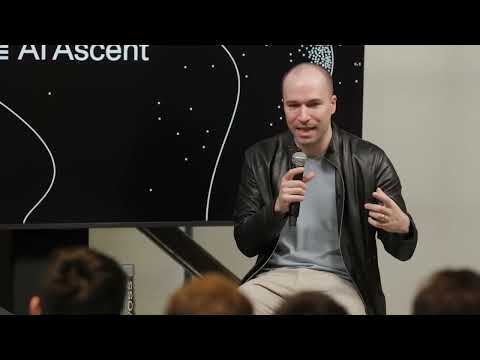
OpenAI's Greg Brockman - Compute & Scaling Laws Mystery
- Length
- 6 min
- Language
- English
- Text from
- the video's captions
- Transcribed
- 13 October 2026
Summary
Greg Brockman of OpenAI explains the company's compute strategy, describing the business as buying, renting, and building compute to resell at a margin, and insisting demand always outstrips supply. He discusses scaling laws as an empirical, still-unbroken phenomenon, ongoing architectural and algorithmic innovation beyond the original transformer, and OpenAI's formal definition of AGI, estimating we are about 80% of the way there. He closes with an anecdote of a model autonomously completing and optimizing a complex systems design overnight.
Key points
- OpenAI's business is described as buying, renting, and building compute and reselling it at a margin, and it should scale as long as the margin is positive.
- Brockman says OpenAI definitely does not have enough compute and has been unable to keep up with demand since the ChatGPT launch.
- He views scaling laws as a deep, empirical mystery with no wall, where more compute yields correspondingly more capable models.
- Innovation continues beyond the 1940s-era neural network idea and the 2018 transformer paper, ranging from micro tweaks like data formatting to larger shifts like LSTM to transformer.
- OpenAI has a formal definition of AGI, and Brockman estimates we are about 80% of the way there.
- He considers current models more capable than he is at writing software, including writing kernels.
- A systems engineer gave GPT 5.3 a complicated systems optimization design document overnight, and the model implemented it, profiled it, and iterated to an optimized result.
Questions it answers
00:00Compute strategy
Why is OpenAI so aggressive about securing compute?
Brockman describes a simple business of buying, renting, and building compute and reselling it at a margin. Since demand for intelligence is unlimited and current AIs can rise to almost any problem, you want to scale as long as the margin is positive.
- OpenAI resells compute at a margin and wants to scale it.
- Demand for intelligence is unlimited.
- Current AIs can rise to effectively any problem.
00:46Compute shortage
Does OpenAI have enough compute?
No. Brockman says they are constantly hunting for more and have never kept up with demand since the ChatGPT launch, when he told his team to buy "all of it."
- OpenAI definitely lacks sufficient compute.
- Since ChatGPT launched, compute ramping has never matched demand.
- Matt Garman said GPU compute availability in 2026 rounds to zero.
01:24Scaling laws
Where do the scaling laws stand — are they still holding?
Brockman calls scaling laws a deep, empirical mystery that feels like a fundamental truth of the universe. More compute keeps making models more capable, and there is no wall.
- Scaling laws are empirical without complete theory behind them.
- Neural network ideas from the 1940s scale with more compute.
- There has been no wall to scaling so far.
02:50Architectural innovation
Is OpenAI just scaling old ideas, or inventing new architectures?
Constant innovation is happening, from micro tweaks like data formatting to larger shifts like LSTM to transformer. Brockman says OpenAI has led long-term research on architectures and fundamental algorithms and sees lots of fruit on the horizon.
- Innovation ranges from micro tweaks to paradigm shifts.
- Everyone has moved past the transformer as described in the 2018 paper.
- OpenAI claims leadership in long-term architecture and algorithm research.
04:02AGI progress
Does OpenAI have a formal definition of AGI, and how close are we?
Yes, there is a formal definition, though everyone has their own intuitions. Brockman estimates we are about 80% of the way there, with models that are very capable — more capable than him at writing software, including kernels.
- OpenAI has a formal AGI definition.
- Brockman estimates we are about 80% of the way to AGI.
- Models are more capable than Brockman at writing software and kernels.
04:49Overnight optimization example
What concrete example shows how capable current models have become?
A systems engineer handed GPT 5.3 a design document for a complicated systems optimization before sleeping. The model implemented the spec, saw it was slow, added instrumentation, ran the code, used a profiler, and iterated multiple times to an optimized result by morning.
- GPT 5.3 autonomously implemented and optimized a systems design overnight.
- The model profiled and iterated on its own code without human intervention.
- Massive gains are possible even on low-level tasks with the right setup.
Notes
Compute as the Business
- OpenAI's business is simple: buy, rent, and build compute, then resell it at a margin.
- As long as the margin is positive, scaling makes sense because demand for intelligence is unlimited.
- Brockman says OpenAI does not have enough compute and is constantly hunting for more.
- At the ChatGPT launch he told his team to buy "all of it," predicting they could never keep up with demand — which has held true ever since.
- Matt Garman reportedly said GPU compute availability in 2026 rounds to zero.
Scaling Laws
- Brockman calls scaling laws a deep and beautiful mystery — empirical, without full theory, yet feeling like a fundamental truth of the universe.
- Neural networks were designed in the 1940s, before computers, and pouring more compute into them keeps making them more capable.
- There is no wall to this scaling so far.
Architecture and Research Innovation
- It is oversimplified to say we just put a 1940s neural network in a gigawatt data center.
- Innovations range from micro tweaks (e.g., fixing data formatting) to major shifts (LSTM to transformer).
- Everyone has moved past the transformer as described in the 2018 paper.
- OpenAI has been among the most invested in long-term research on architectures, algorithms, and paradigm shifts, and Brockman sees lots of fruit on the horizon.
AGI Progress
- OpenAI has a formal definition of AGI, but everyone has their own intuitions about it.
- Brockman estimates we are about 80% of the way there.
- Current models are more capable than he is at writing software, including writing kernels.
Autonomous Systems Work Example
- A systems engineer prepared a design document for a complicated systems optimization and handed it to GPT 5.3 overnight.
- The model implemented the spec, noticed it was slow, added instrumentation, ran the code, used a profiler, and iterated multiple times to an optimized result.
Text from the video's own captions. Summary and notes written by AI from the transcript, so check anything important against the recording.
Recently transcribed
- Greg Brockman on what the best engineers and leaders do today
Allie K Miller · YouTube · 23 min
- Sacks, Andreessen & Horowitz: How America Wins the AI Race Against China
a16z · YouTube · 1 h 17 min
- Trump's Tech Czar on Crypto and American Innovation
a16z crypto · YouTube · 1 h 18 min