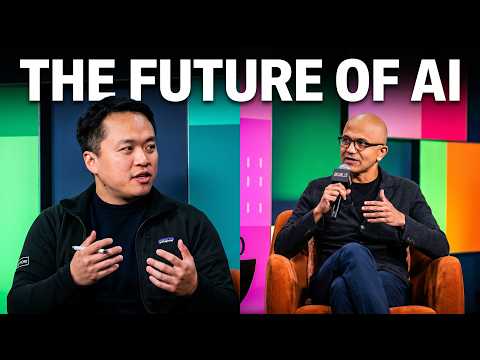
Satya Nadella on AI: @NoPriorsPodcast x Latent Space Crossover Special at Microsoft Build 2026
- Length
- 41 min
- Language
- English
- Text from
- the video's captions
- Transcribed
- 13 October 2026
Summary
At Microsoft Build 2026, Satya Nadella joins a crossover episode of No Priors and Latent Space to discuss Microsoft's AI strategy. He frames AI as an ecosystem play where every company can build its own frontier intelligence using models, harnesses, private evals, and data. He covers SaaS unbundling, pricing models, engineering roles, data center buildout, community impact, and education, arguing that companies must reconceptualize their work around agents to make the impossible possible.
Key points
- Nadella says the biggest takeaway from Build is that AI should be an ecosystem play, not a single model or platform, so any company can participate as a first-class creator of AI.
- The MAI models were built with a clean pre-training lineage, and Microsoft pairs them with a hill-climbing scaffold so companies can build specialists using their private evals and data.
- He wishes the industry had earlier understood that the true eval is real-world value delivered, not benchmarks, and that tokens create value at every step.
- Coding has worked so well that the IDE must be rebuilt around many agent sessions, with canvases replacing chat as the only artifact.
- A company's private evals may be its biggest IP; the acid test is whether you can switch from model A to model B and still hill climb.
- SaaS data models and business logic remain valuable, but vendors must unbundle and re-bundle them with new business models, as Microsoft is doing with Work IQ in M365.
- Pricing will mix per-user subscriptions, consumption metering, and outcomes, because customers love outcome-based pricing until they realize it's like giving away royalty.
- The Azure networking team reconceptualized its job as building the agentic system that does Azure networking, asking for tokens instead of headcount.
Questions it answers
00:00Build takeaways
What was the most important takeaway from Microsoft Build 2026?
Nadella says the biggest takeaway is conceptualizing AI as an ecosystem play rather than a single model or platform, so any company can participate as a first-class creator of AI with its own frontier intelligence.
- A platform is defined by creating more value above it than it captures.
- The keynote focused on the recipe, stack, and tooling for companies to create their own AI.
01:24MAI training strategy
How did Microsoft approach training the MAI models?
Microsoft built MAI models with a clean pre-training lineage, careful ablations, and high data quality, then wrapped them in a hill-climbing scaffold so companies can build specialists with their own private evals and traces.
- Many open-weight models excel on benchmarks but not in practice.
- A 5B reasoning model with collected traces can outperform, as shown in the Land O'Lakes demo with GPT-55.
05:06Reflections on the last two years
What does Nadella wish he had known two or three years ago?
Scaling laws held, but the industry underestimated the real-world complexity of deploying models to deliver measurable value. The true eval is people doing unique things they can value, not benchmarks.
- "Intelligence is log of compute" roughly works.
- Token max complaints are an artifact of not framing tokens as value creation.
07:05Use cases and harnesses
Where is AI creating value beyond coding, and what is the harness concept?
Coding works so well the IDE must be rebuilt around many agent sessions and canvases. Beyond code, durable long-running agents amplify glue work and judgment work. The harness defines models, data, and tools in a loop, and Microsoft's GitHub harness is open and available in Foundry.
- M-Dash found vulnerabilities Mythos missed, proving multimodal harnesses perform in the real world.
- Rich context preparation is where the magic is for efficient plan execution.
17:10SaaS and Work IQ
Is SaaS durable in an agentic world?
SaaS data models and business logic remain valuable, but vendors must unbundle and re-bundle with new business models. Microsoft's Work IQ exposes M365's captive data as a database, creating 10x more value-creation opportunity.
- Nadella can point Work IQ at a GitHub repo with his meeting transcripts and get a code-change plan.
- Mailboxes must be re-architected to serve agents, not just end users.
21:20Pricing models
How will AI software be priced?
Per-user subscriptions, consumption metering, and outcome-based pricing will all coexist. Customers love outcome pricing until they realize it's like giving away royalty, so flexibility matters.
- GitHub added consumption pricing after agent usage intensity outgrew per-user Copilot pricing.
- There is no one business model to rule them all.
27:55Engineering roles and ambition
How will engineering roles and organizational ambition change?
Roles will evolve through experimentation: LinkedIn created a full stack builder discipline, and infrastructure science is critical even for app teams. True ambition means making the impossible possible by reconceptualizing work, as the Azure networking team did by building the agentic system that does their work.
- The generalist role will see maximum leverage and returns.
- The Azure team asked for tokens instead of headcount, making their work meta.
33:50Data centers and society
How does Microsoft think about data center buildout and community impact?
The buildout is unprecedented — more Azure capacity in 15 months than the first 15 years — but the industry must deliver tangible community benefits like stable energy prices, water replenishment, jobs, and tax base, or it will lose permission.
- Communities should be skeptical and ask hard questions.
- Using lots of energy only works historically if you create broad societal value.
Notes
Ecosystem Play and MAI Models
- Nadella frames AI as an ecosystem, not a single model or platform: a platform creates more value above it than it captures.
- MAI models were built with a clean pre-training lineage, careful ablations, and good data quality; many open-weight models look great on one benchmark but fail in practice.
- A small 5B model can hill climb with the right scaffold, traces, RL, and private evals — demonstrated with GPT-55 traces and a 5B reasoning model in the Land O'Lakes demo.
Lessons and Value Creation
- Scaling laws held — "intelligence is log of compute" — but the industry underestimated the real-world complexity of deploying models to deliver measurable value.
- Coding success forces rebuilding the IDE: 100 agent sessions create cognitive load, and chat alone is insufficient, hence canvases.
- Glue work and judgment work can be amplified by long-running, durable agents with delegated authority, like autopilots working overnight.
Harnesses, Evals, and IP
- A harness defines models, data, and tools in a loop; Microsoft's GitHub harness is available in Foundry and works with any model or open harness.
- M-Dash found bugs and vulnerabilities that Mythos did not, proving multimodal harnesses can outperform in the real world.
- Private evals may be the biggest IP. Acid test: if you can switch from model A to model B and still hill climb, you're in control.
- Company veteran agents trained on traces between humans and agents could go on the balance sheet, capturing tacit knowledge human capital never could.
SaaS, Pricing, and Roles
- SaaS data models and semantic layers (e.g., Power BI) remain valuable; the business model must unbundle and re-bundle. Work IQ exposes M365's captive data as a usable database.
- Pricing will combine per-user subscriptions, consumption meters, and outcomes — customers love outcomes until they realize it's giving away royalty.
- LinkedIn created a "full stack builder" discipline; infrastructure science and generalist roles with high leverage will be most exciting.
Ambition, Data Centers, and Society
- The Azure networking team reconceived its job as building the agentic system ("Miles") that does Azure networking, requesting tokens instead of headcount.
- Microsoft built more Azure capacity in 15 months than in the first 15 years.
- Communities must see tangible benefits — energy prices, water replenishment, jobs, tax base — or the industry loses permission.
- Education needs new incentives, credentials, and pedagogy; the next big startup could be a new university.
Text from the video's own captions. Summary and notes written by AI from the transcript, so check anything important against the recording.
More from Latent Space
Recently transcribed
- Greg Brockman on what the best engineers and leaders do today
Allie K Miller · YouTube · 23 min
- Sacks, Andreessen & Horowitz: How America Wins the AI Race Against China
a16z · YouTube · 1 h 17 min
- Trump's Tech Czar on Crypto and American Innovation
a16z crypto · YouTube · 1 h 18 min