Full transcript
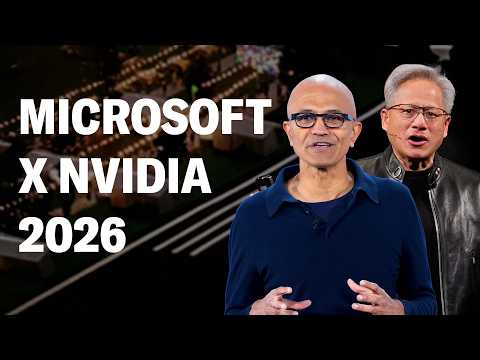
Microsoft Windows Event with Satya Nadella and Jensen Huang | LIVE
Hybrid intelligence and local models
00:00models, runtime, and silicon, all working together to create a meaningful experience. We're working with the GitHub team to bring our vision for hybrid intelligence to life on Windows. Earlier this year, GitHub launched Hydro Fusion, which routes each task to the right model in the cloud. Today, we're extending intelligence to Windows, letting Hydrofusion tap into models running locally. >> [applause] >> Now let's talk about these models. At Build, we introduced Miode1 and Flash, a 130 billion parameter coding model built for real world developer workloads. Now we're bringing that same intelligence to your device. This is where full stack engineering comes in. We have taken that model to three bits of precision,
00:52reducing its size by nearly 80% while preserving coding quality. That is an incredible feat of engineering. But really, shrinking the model to the device is only half the story. MAI code can work at impressive 256K context window right on your device. [applause] Now, our goal our goal is simple. Let AI run locally, stay responsive while leaving the room for everything else on your PC. And there are many more powerful models coming to Windows. Nvidia is working on a new Neatron model. At over 70 billion parameters, it manages to quantize to 2bit and uses just over 20 gigs of memory, making it ideal to run on RTX Spark. [applause] And why why stop there? With advanced quantization methods, it's possible to
01:47bring more of the frontier to your PC. At 1.6 6 bits deepsee flash v4 a 284 billion parameter model is running locally on device fitting in just that's right it's quite amazing fitting in just 60 gigs of memory this model outperforms GP5 encoding and reasoning benchmarks a year ago such capabilities were exclusive to Frontier cloud models now you can have these capabilities running on your PC and this is just the understanding to power this growing ecosystem of highly capable models, you need a performant runtime. And this is where Windows ML comes in. Windows ML is a scalable runtime to deploy models across GPUs, NPUs, and CPUs. And we're continuously evolving it. We're excited to announce we're bringing Llama CPP to
02:40Windows ML. [applause] This gives developers more choice. Open source models on day one, the ability to experiment quickly with emerging models as they land. With intelligent routing, highly capable models, and a performant runtime, a clear recipe emerges for what hybrid intelligence looks like. That's the repeatable pattern we'll apply to light up experiences across coding, security, creation, and work. Kayla is here from the GitHub team to show you this in action. Come on over, Kayla. [applause] >> Thank you, Pavin. I'm excited to show you how I'm going to use the best of cloud and local models to do my coding workflows in GitHub Copilot on Windows. So, to start, let's just paste in a simple prompt. And I have the Windows
GitHub Copilot demo with Kayla
03:34terminal codebase cloned onto my machine. So what I'm asking is I want our agent to detect unused code, imports, packages, and obsolete feature flags. And then give me an actionable summary. So this is just basic code cleanup that I'd like our agent to do. And then here at the bottom, you might notice in the model picker, I have auto efficiency enabled. So this is going to select my model depending on the complexity of the task. And now with our new version of auto, it will automatically pick a local model depending on if that is a more simple task. So here we could see on the left hand side our GPU has ticked up and that's because we're leveraging our local model here and I did run this same
04:16prompt before on a different codebase and we could see that it leveraged MAI code 1.1 flash local. Now since my code is cloned to my desktop and my model is local we could just put our whole machine into airplane mode and this process will still continue to turn because everything is right here on the device. So this is just a simple coding task right to the local model. But what if we asked something a little bit more complex? So in this session I asked our model to or I asked our agent to look at the issues in the Windows terminal repo that has that have the needs repro labels. So these are issues that our team hasn't been able to reproduce. And then I wanted to do some investigation and then hand off to some local sub
04:59agents to do further building and testing and see if we can get more information here. So this prompt actually ended up leveraging GPT6 Luna. So this is a cloud session here. And then we've got three local sub sessions happening on the lefth hand side leveraging MAI code 1.1.1 flash local. So this is a really great example of hybrid intelligence. If I hop into one of these local sessions, we can also see all of the tokens that I got for free. And on this one in particular, we've got 1.6 6 million being sent to the model and then 10 and a half thousand coming back from the model. And all of this was free and this was just one of the sub sessions that I ran. So I have a lot of sessions going. I like to take a look at
05:41what I've got running on my machine and what I've run before. So we have a canvas that we created that is a really great visualizer of my sessions. So a canvas is a custom UI that works inside the copilot app where both you and your agent can work back and forth and update the UI accordingly. So here in our visualizer, all of my purple sessions are local sessions that I've run with our little leaf and all of my blue sessions with the cloud are cloud sessions that I've run. And you might notice I've got the same session happening a few times. I'm doing issue triage a lot and I'm doing it locally. And that's because issue triage is one of the tasks that takes a while and it's something that we have to do pretty
06:18frequently. So I've actually set this up as an automation. So automations can run on a cadence or on a trigger. And I've set my issue triage one to leverage the local model explicitly. So I know for a fact that it's going to use just the model on my machine and it's not going to spend any credits without me knowing. So I can have this running overnight and I'm still getting all of those tokens for free even while I'm asleep. So these are just a few scenarios that I've showed today. Imagine how much more you can save doing these workflows always on even when you step away. Thank you so much. I'm going to hand it back to Pavin. [applause]
06:58Thank you, Kayla. That was awesome. Hybrid intelligence Windows powered by Hydra Fusion will be coming to the GitHub Copilot app, CLI, and VS Code starting October 15th. You've seen how Windows is the most secure platform for hybrid intelligence. Now, to make AI a part of everyday life, we need to bring it to places people use the most into the flow of human ambition. We're moving toward a future where everyone can simply express what they want and their Windows PC with their permission can take action on their behalf. For hundreds of millions of people each day, search on the taskbar is where intent begins. So, it's only natural our story starts there. At its core, the new Windows search experience is quicker, more efficient,
Windows search quick actions
07:46so you can find your apps, settings, and files faster. Starting this fall, on Windows 11 PCs, you can take thousands of quick actions directly from search on the taskbar. You can switch to dark mode. You can turn on do not disturb to help you stay focused. You can turn up your mic volume and then use the inline slider to get to the exact level you want. All of this as fast as you can type. And actions can do more than just settings. You can take a screenshot directly arrange your windows all from the taskbar. And my personal favorite, you can send a text message to a friend or colleague just letting them know you're running a little late without having to pull your phone out of your pocket. A quick intuitive way to move
08:36from intent to action. [applause] And of course, right from the taskbar, you'll be able to connect to the new Copilot app when your request calls for it. Ask a quick question and Copilot will bring the answer right there to you in line in search. If you want to have a richer conversation, you can jump directly from search to the full copilot app to tell you more about the copilot experience on Windows. Please welcome Jacob. [applause] Thanks Bobin. Recently we introduced the new co-pilot with three core experiences. home code and autopilot. Today I'm really excited to talk to you about how Windows hybrid intelligence supercharges everything that we've just brought to market. First, let's turn it
Copilot app with local context and actions
09:33on. Copilot now has access to three new things. First, local context. Local context means that Copilot can now ground over all of the files on your PC the exact same way that work IQ helps businesses ground all over all of their business context in the cloud. Second, local actions. Local actions means that Copilot can actually take action directly on my machine. It can move files. It can change a setting. It has the same level of the ability to control and change things that I do as a user, but always with permission. Third, local models. Copilot will still use the cloud for the hardest tasks, but for times when cost or privacy matter more, it can delegate down to local models that run directly on your computer. So,
10:22let's take a look at how this transforms the rest of Copilot. Let's first talk about home. Home is the new starting point for C-Pilot. We started by bringing together chat and co-worker. We also introduced Office in Copilot, which brings full rich document editing and collaboration from Office directly into the Copilot app. And today, Home gets even better with hybrid intelligence. Home now knows what's on my PC. And so the exact same local files that I've been working on locally myself can now be turned into collaboration ready artifacts directly inside of Copilot. Next, let's talk about code. Code is the easiest way for anyone to build and share an app. No developer experience required. Hybrid intelligence makes code better in
11:12three key ways. First, you can now build a native Windows app from a single prompt. This means unlimited apps and widgets all native on Windows directly from the C-Pilot app. Building software for Windows has never been this easy. Next, we introduced MXC support. MXC support means that your code, even locally, is running in the sandbox that we heard about earlier. This means for the first time, not just developers, but anyone can write and run code on their local machine with confidence. And lastly, local models. Copilot is now able to hand work down to a local model as it's coding. This means that projects move faster and cost less just like we saw in GitHub Copilot. These three things into your personal software factory. We
12:07really can't wait to see what you build. Lastly, I want to talk about autopilot. Autopilot. Enterprisegrade longunning autonomous agent. Let's see how hybrid intelligence makes autopilot even better. We'll flip over to a quick demo. So, over the last couple weeks, maybe a little bit late, I was working with Autopilot to pull together a bunch of stuff to file my taxes. And so, I'll go ahead and just kick off this simple prompt. And the first thing that Autopilot will do is it'll go into my inbox and it'll find the email from my accountant and it'll look for the specific list of files that we have to pull together. Now, because of hybrid intelligence, Autopilot can now ground against my entire PC. And the documents I need to
Autopilot tax filing demo
12:53file for my taxes are all over the place. They're in downloads. They're in documents. Half are organized, half aren't. That doesn't matter. Autopilot's able to use hybrid intelligence to ground over absolutely everything with local context. With my permission, it starts to organize. It moves everything into a new folder, pulls things together, and actually starts to rename files. Now, all of this organization renaming is actually happening with local models. my tax details are not going to the cloud. It creates some subfolders here to give a little bit more structure and then it finishes by zipping everything that it found into a single zip file that I can easily send to my accountant. Now, autopilot of
13:29course always goes one step further uh and it also actually gohead goes ahead and composes an email for me to send directly back to my accountant with the zip file that I just created attached. But of course, it pauses here and it makes sure that I'm good to go. I review everything. This looks great. We can go ahead and send the email. And just like that, all of these files are now sent off and in my accountant's hands and we're good to go. So that's Windows [applause]
14:00hybrid. C-Pilot now truly understands your PC. It's able to take action on your computer. It's able to keep sensitive work on your device. And at every single step, you're in full control. Really, it's C-Pilot built natively for Windows. Copilot features that are powered by hybrid intelligence are coming to C-Pilot over the next couple months. And with that, I'll hand things back to Pavin. [applause]
Ecosystem agents and Perplexity demo
14:32Thank you, Jacob. We're excited to bring hybrid intelligence to Copilot. Windows is the largest open enduser computing platform. So along with great Microsoft experiences, our broader ecosystem is also taking advantage of Windows platform capabilities. We're seeing popular agents like Hermes, OpenClaw, and Perplexity building local AI experiences on Windows. Here's an example from Perplexity. Let's say you're an aspiring photographer trying to get off the ground, and you have a folder of photos from a recent photo shoot that you want to turn into a professional gallery for your client. Normally, that means you'd be paying for a service, resizing images, building a page, bringing it all together. That
15:14takes multiple steps and multiple tools. With Perplexity's portable computer on Windows, you can just describe what you want. Resize the photos and build a local gallery. Perplexity takes it from there, finding the photos, checking the tools on my PC, and building the gallery. You define the outcome, and Perplexity figures out the next steps. The model is running locally on the PC. Processing stays on the device without using Proplexity computer credits. And here it is. 12 photos in a browsable gallery complete with titles and image details. We're also excited to announce Muse is coming to Windows as a native app with MXE integration. [applause]
16:05To achieve our vision of bringing unmetered intelligence to every desk in every home, you need a broad range of PCs and silicon from a mini desktop PC to a commercial laptop to a supercomput. Let's start with the mini desktop PCs or claw boxes as people call them which millions of people use today. It's a natural home for a device and an agent that needs an always on device. An agent that keeps working even when you step away. Today, we're excited to announce a new get started experience in Windows. I'm excited for this because it's something customers are asking for. A simpler, more secure way to get started running agents. This a this experience makes setting up popular agents fast, just a few clicks
Copilot Plus PCs and Surface Laptop Ultra reveal
16:48right out of the box. No terminal, no complicated configuration. And for those of you using OpenClaw, we're introducing a native Windows gateway with a simpler setup. And because all the popular agents are adopting MXC, you can now get these agents running securely on Windows. This is just the beginning. As we continue to learn from our customers, our ambition is to bring secure agentic experiences to the billion people who use Windows every day. Next, Copile Plus PCs, your PC for everyday AI. We introduced these thin, light, powerful PCs two years ago with power efficient NPUs that run everyday tasks locally. Today, over 40% of the laptops being built for business are Copilot Plus PCs, tens of millions of PCs a year. And
17:36we're seeing over two trillion inferences per month running locally, improving customers experiences across search, imaging, and video calls. The hybrid intelligence experiences you just saw from Jacob will take advantage of local AI on Copilot Plus PCs. And then there's the builder tier. To create a new class of devices for builders, we needed to understand what matters to them and push the boundaries of hardware engineering. I want to introduce you to Surface Laptop Ultra, the most powerful Surface we've ever built. Let's take a look.
18:35I [music] want a little bit of something so good. I set a fire to watch it burn. [music]
18:51[music]
18:57[music]
19:07Heat. Heat.
19:18[music]
19:23>> [music]
19:37[cheering] >> This [applause] is Surface Laptop Ultra. We built it for developers and creators pushing the limits of performance who want portability with exceptional craft. I've been using Surface Laptop Ultra for the past few months and it's an absolute gamecher. Developers push their machines hard. Here's an intensive developer workflow with GitHub Copilot. But a demanding task shouldn't mean putting everything else on hold. While that work continues, a film is being mastered in Da Vinci Resolve. This kind of mastering takes serious performance. The CPU, the GPU, and memory all working together while the developer workload is still running. And Gears of War, which released yesterday, has been running on this machine the
20:29entire time. And it runs awesome. [applause] It runs simply awesome at 60 frames a second. Work, create, and play. So you don't have to choose just one. Now, it wouldn't be Windows and Nvidia without talking a little bit more about gaming. At launch, hundreds of AAA titles that you love and the indies that you play will be great on RTX Spark. And we're super excited to announce that in 2027, Call of Duty will be coming to RTX Spark. [applause]
21:11Getting here took Surface, Windows, and the Nvidia team building a new platform from the ground up. When three teams come together, you get something none of us could have built alone. And for that, I am deeply grateful. We built Surface Laptop Ultra around Nvidia RTX Spark. It took end-to-end engineering, design, and full stack thinking to unlock what local AI can do. With up to 128 gigs of unified memory and up to a pedlop of AI compute, you can run models on this laptop that simply don't fit on a traditional machine. Surface Laptop Ultra is engineered beautifully inside and out. It has more than two and a half times the thermal capacity of our existing laptops. So, it stays faster even under sustained load.
22:01And you don't have to worry about sacrificing performance when you're unplugged on battery. It can maintain over 99% of its power while on battery power. And that's great because it's portable, under 18 mm thin, and less than 4 12 lb. I also love our new Pixel Sense Ultra Touch display. It has the brightest peak HDR of any laptop. It looks incredible. Our Surface Laptop Ultra has the most ports on a Surface Laptop. Our customers have told us they love magnetic charging and they love the versatility of USBC. So, we invented magnetic connect, the world's first built-in magnetic USBC charging. [applause] I know. Just bring the connector close and it snaps right into place. Easy magnetic charging without giving up the USBC
22:58port. But that's right. This kind of awesome. [applause] But the real measure of all of this power is what happens when it's in your hands. When you can close the distance between what you can imagine and what you can create, that is amazing. That matters because the future of AI is not about having just one model. It's about having the right model at the right moment. Frontier capability when you need it, smaller, faster models when you want speed, responsiveness, and the room to keep the rest of your workflow running. Surface Laptop Ultra is built for that future. It brings new ideas to life with advanced graphics, unified memory, and local AI working together. Let me show you how one of our designers
23:45put all of that power to work, combining local and cloud AI to bring his creative vision to life. >> Hi, I'm Danilo and I'm a senior designer at Microsoft. In my day-to-day work, I'm building products, but outside of work, I have a true passion for creating concept art. I love creating concept vehicles in sci-fi worlds and I'm about to show you a workflow that used to take me days and now just takes me a few hours. One of my favorite tools is Blender. Here I'm building a spaceship from scratch, modeling all the details, texturing, lighting, and rendering. I could keep going, but if I wanted to bring more of my story to life and create an entire world around the spaceship, it would take me days or even
24:32weeks. That's where local AI can be really helpful. It lets me explore ideas faster. Here I'm using Confi, an app that lets me download and run AI models locally. I started by importing some of my renderers as reference images and use a Gemma 4, an image to text model to generate [music] a description of the world and a list of assets that match the style and elements of my images. Then I imported another image with close-up details as reference along with asset descriptions generated by Gemma 4. Using Flux 2D dev, an image [music] to image generation model, I create an image of each asset. After running several generations, I end up with [music] a folder full of assets. Next, I imported my favorite images into Hoon 1
25:163D 2.1, [music] an image to 3D model to generate the 3D assets. I then brought all these assets into Blender so I can start building [music] my scene. Using a highly capable coding model running fully on my device, I wrote a [music] basic prompt and generated several layout options using my assets. After choosing the one I liked, I kept exploring and refining my scene, adding more elements and tweaking the overall composition. Once I was happy with it, [music] I rendered the scene, brought the images into Photoshop, and painting over areas I wanted to refine, adding elements like smoke and adjusting [music] the overall color and mood. Then I took the finished image back into coffee and used [music]
25:57one 2.2 an image to video model to generate the final animation. In my final step, I used GPT6 [music] Astra in the cloud to take things even further. I uploaded my final files and asked the agent to build a scene in Unreal Engine that could actually walk and fly around [music] in. So this is the result. This would normally take me days, but now only takes hours. All on my Surface Laptop Ultra. [applause]
26:36What you just saw is Dino using multiple local and cloud models in a variety of different apps, bringing his creative vision to life, shaping the design, refining the details, staying in control of his entire workflow. What used to take Danello days now takes hours. That's what we mean by hybrid intelligence. The new Surface Laptop Ultra is built for this new era of creative work. Across the models we tested, Surface Laptop Ultra delivers faster time to first token performance for language models and shorter image generation time than M5 Pro powered laptops. This is where having both the large memory and the pedlop of AI compute on a single device is a distinct advantage. For builders using local AI, that means
27:21less waiting and more creating on Windows. Since build, many of you asked about the Surface RTX Spark Devox for built for those of you who want to push local AI development even further. It ships with Project Zenith, a ready to code Windows experience preconfigured out of the box so you can build from day one. I'm excited to share that both Surface Laptop Ultra and the Dev Box are available today for pre-order. [applause]
27:56In addition to Surface, we've built a broad device ecosystem. NVIDIA has been our close partner on this journey. RTX Spark brings powerful AI compute to the laptop. DGX station takes it even further. Look at the ecosystem bringing this to life. Lenovo Yoga 92in1, a lightweight convertible design with pen support. Asus Pro RP14, an incredibly thin design with a 4K OLED display. Dell XPS16, a seamless glass haptic touchpad with integrated speakers. MSI Prestige N16, a versatile flip form factor with pen and UHD plus OLED display, HP Omnibook Ultra 16 with a distinctive tower hinge design and gesture controls on the haptic touchpad. And of course, the Surface Laptop Ultra. All of these RTX Spark laptops are available for
RTX Spark laptops and DGX Station
28:57pre-order starting today and will begin shipping next Friday. [applause]
29:07And finally, we have the supercomputer. DGX station for Windows brings data center class performance together with enterprisegrade security and manageability. This unlocks the power to run frontier class models locally from Llama V4 Maverick to Kimmy K2.6 to Deepseek V4 Pro at more than a trillion parameters. Capabilities that once required renting a cluster now in a deskside supercomput. With RTX Spark, we're bringing last year's Frontier to your laptop. With DGX Station, we're bringing last quarter's Frontier to your desk side. Take a look at this. [applause] Take a look at this. For the first time, DGX Station running Windows Live with Dell Precision Pro. Frontier models and agents work locally, taking months
30:00of work, complex work into moments with more control over sensitive data and cost. With the HP ZGX Fury AI station, it shows what happens can work and scale simultaneously across 32 agents, a virtual token factory for development teams. Both coming later this year, running the Windows platform organizations know and trust. [applause]
30:29This is an amazing moment. On behalf of Microsoft, I want to say thank you to all of our partners. Next, Satya Jensen and Shrian Krishna are going to take the stage in a few moments to share their thoughts on the opportunity ahead. Thank you.
30:50>> All full of power as we go. Chase the thing we came here for. Push it further than before. We'll be coming around the thought we [music] can't let go. We'll be coming around the thought we won't let go. Making brick and shaping crafting as we go. Then the pieces [music] comes to life. Let's see how far.
31:19>> All right. [applause] All right. >> [applause] >> Wait, wait, wait. Take the phone. >> No phone calls on stage here. [laughter] Um, first off, was that cool or what? What do you guys think? Huh? >> Yeah. [applause] >> Huge congratulations to Paw, Jacob, the teams at Microsoft and Nvidia. Um, I will say they were kind enough to send me a Surface Laptop Ultra for the last few days. It is amazing, but I think I want the workstation for Christmas. Now, [laughter] now there's a bunch of stuff about the exciting future to get into. But before we do that, I was looking both of you up last night on YouTube, and it's quite rare to see both of these gentlemen on stage together, and I was thinking about
Nadella and Huang fireside chat
32:15how, you know, you both had a history, these two great companies had a history going back decades. You both individually had histories of working with each other going back decades. Ties to me. My first job was at Microsoft. My first paycheck a GeForce FX to play Halfife 2. So, so maybe to start us off and Jensen, what is your favorite memory uh or fun memory of working with Satia and Microsoft? >> Well, uh Nvidia was founded because of Windows. It was 1992, late '92, uh, Windows 3.1. And we were just started to see the the vision of what a what a personal computer really can be. And at the time, frankly, we had never I'd never even see a PC before. I largely worked on workstations. We had, you
33:01know, we had uh file servers and supercomputers that we used to design chips with. and and the founders and I, you know, talked about this future where maybe uh a personal computer with 3D graphics would enable it to do things like games and and be a workstation and design things. And so we we imagined about this world. If not for Windows, uh Nvidia would have been founded. And then and of course and of course we we started in 1993 um uh Windows 95 really made reinvented Windows 95. >> Wow. Am I on >> Windows? Windows 95 made possible the GPU to be connected to uh uh a personal computer. And what revolutionized the GPU was DirectX. Direct 3D uh was the API that really uh enabled us to re uh reveal the
34:04capabilities of GPUs into applications. But then DX8 came along and we co-invented with Microsoft the world's first G programmable GPU which is programmable shaders which a few steps later evolved into uh CUDA as we know it >> and so if you look at the entire journey of our company Windows was at the core of it and if not for Windows there would be no GeForce if no GeForce CUDA wouldn't come to the world uh without CUDA Alex Kresevki and Ilia Suscover um Yan Lakun, you know, uh Andrew Ang, none of them would have uh found a computer uh to do deep learning. >> And here we are. >> And Jensen is now going to do a little transfer of market cap back to me. [laughter] >> I do that every day. I do that every
34:56day. >> But it's extraordinary that journey uh that Jensen recounted. I mean, it's kind of the the it's the history of computing in some sense. Um, and the thing, one of the things, uh, that Jensen sort of sparked for me was he has been perhaps the most consistent with the vision of what accelerated computing can be. And this going back to the trajectory, you've been the one person in our industry who has had this one idea whose sort of trajectory has been the most expansive quite frankly more so than even any single PC form factor or chip architecture. Because I look back, one of my first memories was we were talking about essentially saying in the cloud, how big can be accelerated computing or high performance computing,
35:54right? The first deal I remember was in Azure, how do we make HPC a bigger thing? Um and by the way if >> Satio was the first user of Infiniban inside a cloud which brought the first supercomputer to open AAI which boom >> that's right if we had not done that like the fascinating you know like life is full of accidents but if we had not done that for HPC we wouldn't have had the supercomputer to give to open AI to go train a GPT model and rest would have been history I mean it was kind of one of those happen stance that we had done the HPC see stuff when we were building an Infinibanbased supercomputer and and comes Sam and says, "Hey, do you have computing?" And we said, "Yeah, maybe." And and so it's sort of like but the
36:44thing that I really give Jensen all the credit quite frankly is that consistency of vision of what this can be, not today, not tomorrow, but as a secular trend. And that's kind of what you know brings us even to this moment. >> And then it led to a conversation. It led to a conversation I remember quite well where Satia and I were talking about so so what does this mean to the PC? How do we make uh the the perfect PC in the post era of all of this stuff and you know of course the personal computer is the ultimate tool. It's my ultimate tool and for a whole generation of people it's our ultimate tool. Um, what happens in the era of agents, uh, when when when the agent is on your computer, it is now your personal assistant, but
37:35it wants to have access to all of the amazing tools that we have, but the amazing tools are spread out in the NVIDIA ecosystem into uh gaming PCs, >> yeah, >> into workstations. And that's where most of the tools were, right? all the all the all the do tools and all the seammen's tools and uh autoesk and adobe and you saw many of them just now and you know we wanted the world's best blender the world's best unreal the world's best omniverse the world's best katillaa everything all sitting on the same PC >> um as the AI >> and so how do we go create that by the way took four years >> wow >> that was a four year ago conversation and just incredible >> now that's very a good segway today and Satia. So I think the last few months
38:23you know we've been sort of inundated with these stories of agents and security you know we all use agents I'm sure everybody here is using a muse or uh instinct and you are giving full disk access and you're having it act as you and today when you guys showed MXC it seemed to me like a fundamental new operating system primitive for agents which is a break from where we have been. to maybe talk to us about why the OS is the right place for this and what this primitive if you will opens up. >> Yeah. No, first of all remember this all started with coding agents all running on the desktop. I mean in fact if you sort of look at uh where is the agent that needs this security primitive the most? It's the local harness and its
39:13access to the file system and to be able to take action. And so that's why in fact you know working with Jensen and team we said look how do we w you know wire this in into the primitives whether it's in the cloud or in uh uh in the operating system locally and given the fact that essentially coding went there first where the harness is local even if you were using a cloud model we needed to make the desktop uh the most secure place for agents to execute and so that's where MXC comes from it's fantastic to see open shell now fully integrated and native with MXC the controls that Pavin talked about right which is containment itself has to be done at every level right it's not about sort of doing one thing and leaving the
39:58other right it has to be at the microVM it has to be at the WM it has to be at the session the piece that I'm most excited about is the Windows session having containment right it's so so critical then okay containment is wonderful but then I need full observability how do you get observability you get it if you have an identity for an agent that I can track I can then see the entire exhaust of the agent right all of it uh and then I can govern it that means I can like classic set policy and have it govern that is now what's going to give peace of mind whether it's to IT ops to sec ops uh and by the way and the other thing that we should also not forget is the ability to track the token spend right and where
40:41it's happening and so that's the entirety of what we have tried to together. It's not about any one thing. It's about stitching all these things. Having seen all these adoption cycles, whether it's the consumer adoption cycle, the enterprise adoption cycle, I would say the thing [clears throat] that blocks broad diffusion is not having that complete thought on what is required. Right? So if you do one and leave the other, there's no trust and what have you. So I feel very very good that we have brought it together in the cloud in the in the client across it sack and fin and it's heterogeneous right it's not about any one piece of Microsoft technology it's about supporting it all >> what Satia just said what Satia just
41:24said uh is going to be the foundation of the next generation of it as we know it if you go the words he used what he described the architecture deeply profound for the next generation of computers just as Windows and and DirectX revolutionized how applications were built. MXC is going to revolutionize how agents are built and deployed >> without it started without it complete non-starter and so this big big deal >> now this is I think closely tied to the next piece um for both of you which is hybrid intelligence now this feels a little different I think everybody here has uses large model in the cloud you use it it runs a tool maybe using blender and you get back a response we're all used to that the
42:12in a few years. This feels different where you have a choice of models, some running locally, some in the cloud, you're going back and forth. And one sentence from the presenter who spoke about GitHub stood out to me was you're getting these tokens for free, right? And so maybe talk to us about what this opens up because this feels again something new where you are running part of the workload here in the locally on your on your laptop, part of it in the cloud and intelligently routing between. What does this open up? Yeah. For first of all, you know, I think this is one of those moments where um some of the things that you've been using all click together, right? In fact, it's kind of I was thinking about
42:56this in the late 80s when I was in grad school. I kind of had a a a terminal, right? My VT0000 and a VAX. Um and um and then I had a PC at home. >> Mhm. >> Um and I kind of was using it all. In fact, it's interesting that on my PC I had um essentially a modem with a terminal connecting to my wax and then I had all my local DOSs and uh you know early Windows and what have you. And then suddenly took all and by the way I had Usenet all of that stuff but except it took all the way maybe until 95 and even Mosaic right the first browser to bring it all together as one seamless experience right it's not about local cloud what have you I just want to use my computing power wherever it is in sort of a seamless flow of what I'm
43:56trying to get done so when I was seeing even what Daniel was showing that demo is mind-blowing. I mean, think about that moment. I think we're going to come back years from now and say, "Oh my god, that was when we saw what he did was he went to Comfy UI. He brought down a bunch of models, built a bunch of assets, took it to Blender, uh, used that to even enhance those assets, then used again brought it back to Comfy. Oh, went to Photoshop, used a local model perhaps to sort of enhance it, took it back to Comfy UI, then took it all to the cloud with Astra with Unreal, but he just used apps on his desktop, models, local models in the cloud, it all just worked. That is what this is about. Like that's kind of where today was about
44:47multiple fantastic devices, all these things. But the trajectory for me is so clear. There will never be a moment where we will go and look and say, "Oh, this runs locally. This runs in the cloud." You will expect this hybrid intelligence to be everywhere and pervasive. And I think that that's what to me is pretty exciting. >> Yeah, that one application what you just said, Blender was accelerated, Comfy UI was accelerated, Astra was in the cloud, the agents were locally. I mean that's just the the surface area surface area. That's cool. The surface area of computing was magnificent. >> Yeah. >> It is comp it it brought together literally the entire might of lit every single technology company in human
45:33history came together for that one application. >> That's right. And and by the way going back to sort of the way you talk about accelerated computer that was I mean his point about why he was excited what took him multiple days takes him hours. like that the fact that he was accelerating in his ambition and that to me is pretty cool >> which I I think you know this ties closely to something else because these models have gotten very good at tool use but the tools often live locally you know the files live locally by the way you know Jacob and I are still both of us are filing taxes at the last minute apparently um and and I think there is a aspect here about >> I want my data to be secure and safe in
46:13control. I want the tool use to happen near where the data is where if you look at what Jacob showed with co-pilot like that it really opens up something new. >> Yeah. I mean to me like one of the things right if you look at it in fact one of the when the coding agents became the thing I was excited to see everybody was in love with you know one the console uh and everybody was love with file systems again. It just shows how powerful of an abstraction a file system is. I think agents are going to be the largest users of file system. They need to be secure. >> They need to be because they're a heterogeneous collection space. Uh and what his tax example Jacob SP was a great one. Right. Basically what it did
46:56was it organized from as he said from downloads from even cloud files, email, everything into a file system container and then used models locally and in the cloud to go do stuff with it. And that is the new computer, right? So it's a I use the computer, my agents use the computer, the agents need these primitives as well. And so I think like one drive, when was the last time I thought of one drive as a cloud thing or a client thing? It's there everywhere. And so to me, that is what I think we are beginning to see is, hey, I want my primitives for my agents to use 24 by7. The form factor when I'm using it on my PC should feel like I'm using it on my PC. When I'm roaming, it should roam with me.
47:43>> You know what's amazing, as you know, is is that these agents are going to be better users of tools than us. And the reason for that is just we know 10 15% of the features of [clears throat] any application, but the agent knows every single feature. >> That's right. And so so the the the fact that the tools these incredible tools are sitting on your PC, they're they're accelerated in in this incredible computer Surface Ultra. Uh now the agent has access to all of that capability. Who knows what we're going to be able to do. I mean just look at what it did. It was the Blender, the Unreal, the Comfy AI. It was incredible. Kind of show of hands. How many people here have tried using one of these apps
48:20locally with the model in the last couple of months or a few months? >> Great. Right. And so I think this just kind of show goes to show where you can actually bring the tools locally. Now Jensen I want to ask you about the hardware piece of this right we very often see you talking about these big massive you know Vera Rubins Blackwells NBL72s you know these you know intelligence token factories um you know that's you know that power data centers here today we're talking about something different right like we're talking about the spark the workstation which I really want for Christmas you know which runs in your office talk to me a little bit about how you see this evolution about tokens being produced like right next to you as
49:03opposed to you know Ver Rub in data in the data center. >> Well uh the number of engineers that worked on this project is incredible over 4,000 engineering years. This is a massive project. I mean look what we've done. We've reinvented the personal computer completely for the first time. We took all the capabilities what used to be in a gaming PC, in a laptop, uh in a workstation, in a supercomput in the cloud. We unified the architecture and we made it run on one super chip. This super chip, you know, it's rectangular because it's two giant chips fused together. And so this it's a beast. It has one pedlops. Just to put in perspective, the computer that started the AI revolution called DGX1 was one
49:50pedlop. And it was a quarter of a bill it was a quarter of a billion dollars and um it weighed 500 lb and now it's in this in your laptop. Um but what's what's amazing is this is also the only computer the only computer in the world that runs DirectX and all of its applications OpenGL and every single version of it because we need all of the tools and design tools, right? Creative tools. We need everything to run. We need Unreal to run incredibly well. Also, DirectX has to be amazing and it runs every single CUDA application incredibly. What what uh Satia and I were talking about four years ago is you know we're going to have a whole new generation of software developers and these software developers are going to
50:33be AI software developers. They're either going to be creating AI applications and AI models or they're going to be using AI to to develop their software. And so the computer has to be revolutionized and has to be really good at CUDA from the ground up. And so this is the only computer on the planet that runs everything natively on the device. The first time ever. And so it took thousands of us to do this. But it also took the entire industry. Look behind us. Every single laptop maker, every single do desktop maker, every single workstation maker joined us. >> Yeah. Wow. Yeah. This is the first time I think first time I think a new piece of hardware new computer architecture have come together and the entire
51:16industry top to bottom left to right everybody's involved every single geography and so this is a complete reinvention we understand the seriousness of the work that we're doing doing here we've now test tested some over 1,200 applications the most intense applications in the world all fully tested performance tested compatibility tested everything has been optimized we're going to keep on going the support for this system the the amount of software we're going to bring to it middleware algorithms I mean it will never end this is just a magnificent thing that when you when you finally look at it you look at this beautiful laptop pav stands up here with this beautiful laptop you know but the number
52:00of engineers between our two companies and all of the companies around the world that did this incredible all because we believe that the personal computer was our tool tool for people. Now it's going to be tool for people but is also going to be our personal assistant that uses the tool. Now one last thing for both of you I think if you've been on X for the last few days there has been this intense conversation about I would say personal agents we've been talking about productivity and maybe enterprise agents here whether it is Muse Instinct there's this question about hey when this agent goes out and makes a purchase is that me or the agent who is liable for it and if I'm a service provider how do I react to this
52:40human being no longer showing up on my website and people are trying to build standards and as an industry I think we're trying to figure this out. So I'm sort of curious if you kind of had to peer on the crystal ball a bit. Where do you see this headed? Right? Is it standards? Is the industry coalissing around some new behaviors? Where do you see this headed? >> Yeah, I mean first of all I think it starts with a little bit of the conversation we had uh in the early part which is trust. Um and trust starts with things like hey are these agents contained? Do they have identity? is the exhaust uh of the agent with the identity separate from the user right which is one of Pin's thing was how do we make sure the agent ID that's even
53:20working on behalf is separate from the user and you need it even for everyday uh usage but you also need it for what I think you're referencing which is how do I then trust what do I delegate in fact if you look at the first decision that we are making is what is my delegation um you know authority that I'm giving to the agent uh on my behalf of right and that is a decision that's going to be based on trust and it'll keep increasing the more autonomous it is uh you trusted and gone so then I think on the consumer space this will come down to even you know I I think of it as insurance will price this >> insurance >> because at some level we can all talk about it's not like oath is hard to do right I think the protocols are good we
54:07should do them and t But ultimately it's going to be pricing the the essentially the agent working on my behalf. Uh and how does the marketplace price it? >> Your question at the at the foundation of it MXC is so foundational. Open Shell the work that we're doing together. It's about it's about trust. It's about containment. It's about observability monitoring. If we can't get that right that's right. Oh yeah. >> If we just can't get the right. So that's the first part. We have got to secure that part of it so that the agents that are operating on our behalf, doing things on our behalf, we give it minimum rights. It has credentials. It is monitored and trusted. Only then can we allow these agents to really go off
54:52and do do uh do tasks on our behalf. >> You know, today's a powerful moment. I remember when open clock came out from there with the terminal hacking own um gateway to here where it is an embedded piece of Windows, you know, with tokens running accelerated. It's quite something. >> So much engineering went engineering went into that that the ride today. >> Amazing. And it is a great device. Let me just tell you that honestly. Well, Jensen Satia, thank you so much. It's a great day. Thank you for having me. And I'm going to throw it back to Pavin >> and Satia and Microsoft team. We have reinvented the computer as we know it. >> Thank you so much Jensen. Thanks for the partnership. Really excited today. And I
55:30think as you said like one thing I if I can end with Jensen just in passing talked about the vision for this was how do we I mean Windows has always been about how do we not leave any piece of code any piece of framework behind and bring it all. The fact that he talked about hey we're going to bring all of Windows apps all of the the graphics apps all of CUDA all of OpenGL and now with the token factory that is what is mind-blowing. Windows has been with me for 34 years. Looks like it's going to be with me for 34 more. >> There you go. Thank you so much. [applause] Thank you. Thank you. [applause]
Closing remarks
56:20>> That's a bit hard to follow, but uh absolutely incredible moment for our industry. Just to wrap, we're building the OS for hybrid intelligence. It provides the most secure platform for agents, unlocks unmeeded intelligence. We're bringing AI into the ambition of humans and their flow. And of course, we're delivering it all on PCs that bring it together. Thank you all for your time today. Grateful. [applause] [music]
56:57>> [music]
57:04>> Heat up >> [music]
57:13[music]
57:22[music]
57:27>> here. >> [music]
57:43>> Heat. Heat. [music]
57:52Heat. Heat.
58:07[music]
58:17>> [music]
58:22[music]
59:35>> Heat.
59:54Heat. [music]
1:00:01>> [music] >> Hey,
1:00:10hey, hey.