Full transcript
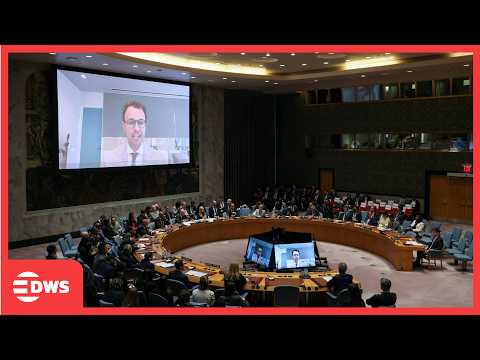
WATCH NOW: Anthropic CEO Dario Amodei Warns UN Security Council of AI Risks to Humanity | AI15
00:00I thank Mr. Altman for his briefing. I now give the floor to Mr. Dario Amodei. >> Good afternoon. I'd like to thank France for convening this meeting and the members of the council for inviting me to speak. AI is advancing very quickly. Four years ago, it could barely write a line of code or solve a high school math problem. Today, it writes most of the code at Anthropic and solves world-famous unsolved math problems. The trajectory only needs to continue for a tiny period longer, one or two years, maybe less, to reach what I've called a country of geniuses in the data center. This rapid pace of progress will produce incredible benefit for the world. Just today, Anthropic announced the Claude-led discovery of a new molecular
00:45machine. It's a preliminary finding, but it may constitute a new gene-editing mechanism that could have applications in in gene therapy. Claude led the literature review, theorizing, and experimental design, and humans ran and verified the experiments in the lab. We believe this type of application will accelerate rapidly in the years ahead and that we can make profound progress in the near future on diseases that have plagued humanity for millennia. But these remarkable capabilities also come with risks that must be managed. I see two main categories of risk. The first is misuse of AI models. For example, misuse by bioterrorists to create biological weapons. The second risk is loss of control.
01:28Model capabilities accelerating beyond developers' ability to control them. These questions are global in scope and concern all of humanity. They are grave enough that I believe they are important questions for this council, not just for economic or ICT ministries. If managed poorly, I even believe that AI could be a risk to humanity as a whole. At Anthropic, we believe we have the best track record in the industry for preventing these risks, both operationally and in our research. We test every model for dangerous capabilities in areas like cybersecurity and biology. We put strong safeguards on our most capable models, and we publish our work in these areas. We have pioneered research in areas like
02:11mechanistic interpretability and alignment science that improve our ability to steer and control our models. We also have unparalleled transparency practices, releasing risk reports that run to hundreds of pages. But, we understand that as AI models become more powerful, even more stringent standards of safety will be required. And we are always aiming to improve our safety and alignment practices, our abilities our ability to prevent misuse, and we are always striving to do better. We will slow down as much as necessary in order to make sure that every successive AI technology that we release is actually safe. But, regardless of what we do, managing these risks is ultimately bigger than any one company. And it has an
02:57industry-wide and global scale. On September 12th, I called for a collaborative effort to pace the frontier, not to stop AI progress, but to work together to make sure the industry and the world can proceed at a rate where we can be sure that safety keeps up with capability for everyone in the industry. This call had three parts. First, we committed to embed external evaluators inside Anthropic with employee-like access, similar to a food inspector. And And we recommended that other companies across the world do the same. Some have already agreed uh uh to adopt this measure. Second, we called for cooperation across the industry to set standards and modulate the pace of progress. And finally, we called for global
03:47cooperation across the world between governments to set international standards. It is this last area that most squarely falls within this council's remit. I want to offer three ideas in this regard. First, we should begin with narrow agreements that every member can support, such as a ban on using AI to make biological weapons or permitting your AI technologies to be used to make biological weapons. Second, we should build evaluation and verification systems that keep pace with AI development so that states can have visibility into frontier model capability and can verify each other's commitments. Third, we should establish common global standards for testing AI models for loss of control risks and misuse risks, and a
04:39notification system for AI incidents that are significant to global security. I believe that this is the most important global security issue facing the world today. For all the differences of the people in this room, we must put aside those differences in order to confront this global opportunity and global threat that is being presented to us at the same time. No leader, no company, and no nation can manage this alone. We commit to working with governments in this room on this urgent work. Thank you for your attention. >> I thank Mr. Amodei for his briefing. I now give the floor to Mr. Klemann de Lange. >> Mr. President, members